
E-Mobility Country Ranking 2024

Munich, May 2024
T

he analysis of the use of e-mobility in 35 countries worldwide shows that unit sales of battery electric vehicles in Europe¹ rose again slightly in 2023. Although 2024 got off to a bumpy start, average BEV sales are still expected to grow compared to the previous year – and are urgently required in view of the CO₂ limits that will apply for manufacturers in Europe as of 2025.

¹ Europe = EU countries + EFTA countries + United Kingdom

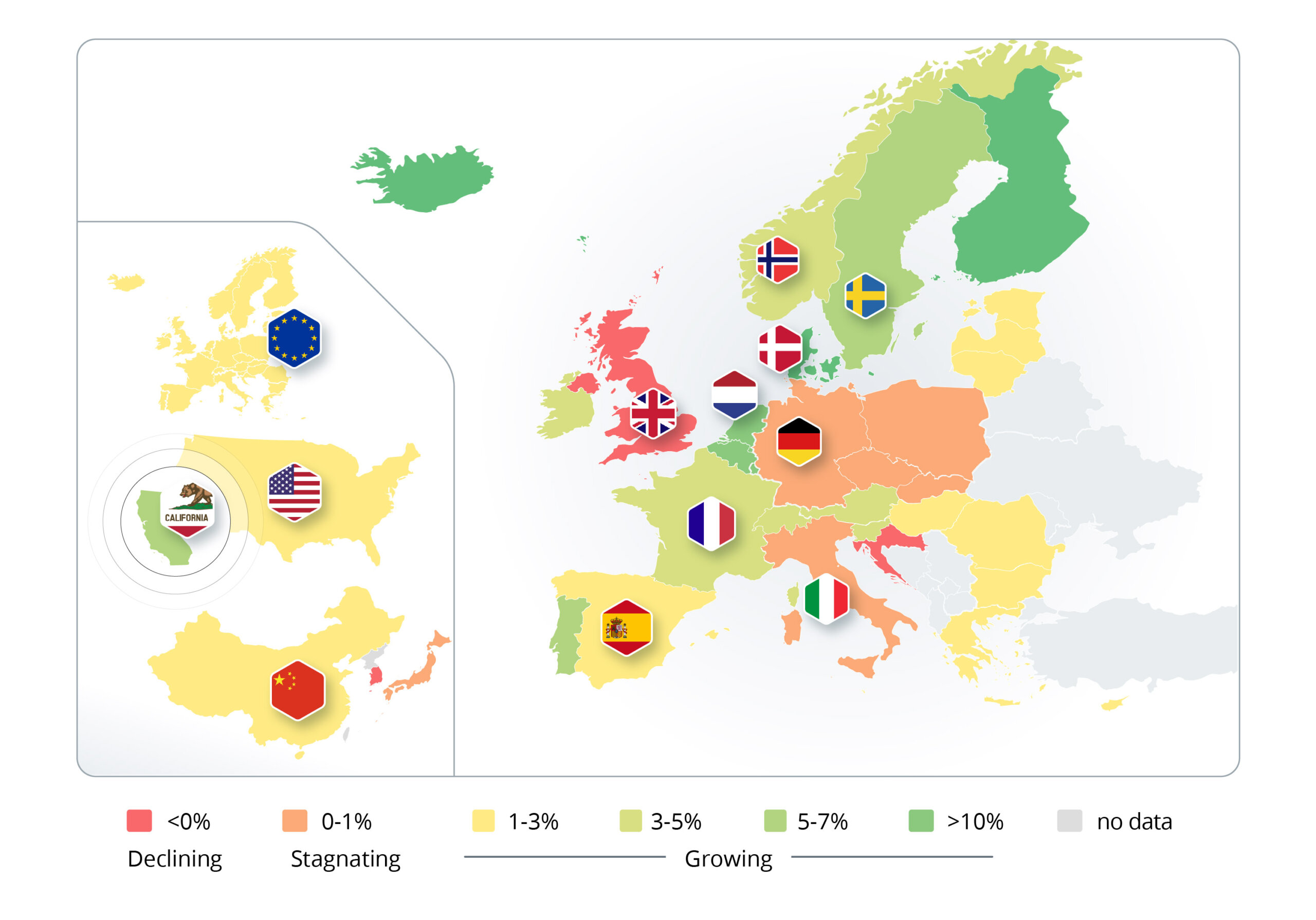
The year 2023 was a turbulent one for both the global economy and the automotive industry. Following the semiconductor crisis and the resulting supply shortage, inflation also made itself felt in terms of vehicle sales. Despite the global challenges the market share of battery electric vehicles (BEVs) continued to grow in many markets, following on from the success of the previous year (FIGURE 1).

However, really strong BEV growth rates were only achieved in certain markets. While Norway remains unmatched at the top of the rankings in terms of BEV sales, Finland has moved up one place and Denmark three, thus overtaking the Netherlands. Belgium has even jumped up six places. These movements reflect developments in the tax models of the respective countries – where taxes on vehicles with internal combustion engines (ICEs) were increased and taxes on emission-free vehicles decreased. By contrast, Germany dropped four places in the ranking and the United Kingdom even lost seven places – two countries where the tax model has remained very attractive for ICEs.

FIGURE 1 DEVELOPMENT OF THE SHARE OF NEW BEV REGISTRATIONS IN 2023 YEAR ON YEAR, BY COUNTRY
(in % points)

Source: Berylls Strategy Advisors

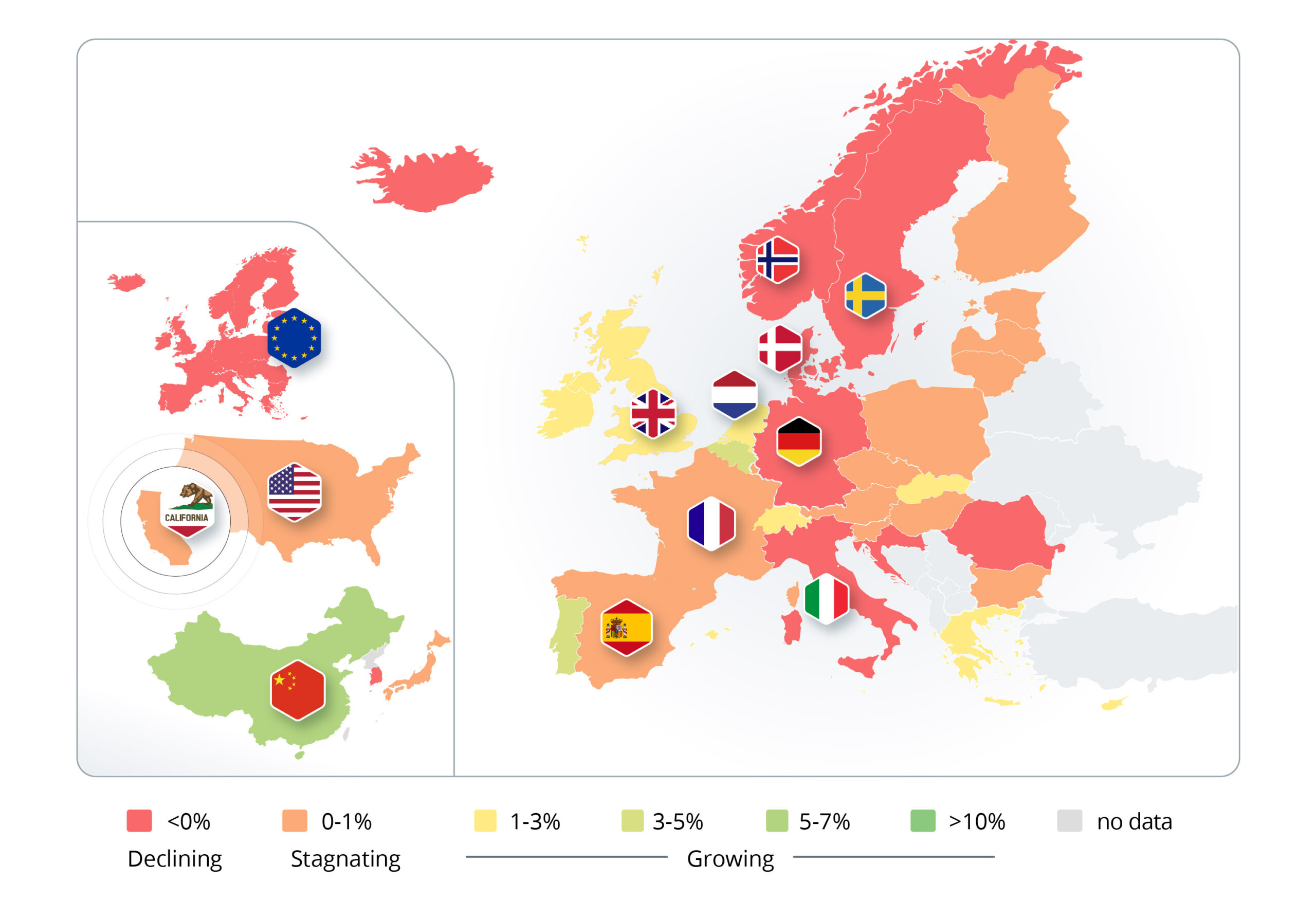
The situation is different for plug-in hybrids (PHEVs), where the negative trend seen the previous year continued, with the proportion of new registrations falling in many European countries (FIGURE 2). Primarily in the Scandinavian countries, it is clear to see that the PHEV era is coming to an end and that they will be replaced by BEVs in the medium term. China, on the other hand, has played a special role with a large increase in PHEV sales over the last two years. As PHEVs are considered “New Energy Vehicles” (NEVs) together with BEVs, they remain relevant for China’s OEM targets regarding NEV vehicles.

FIGURE 2 DEVELOPMENT OF THE SHARE OF NEW PHEV REGISTRATIONS IN 2023 YEAR ON YEAR, BY COUNTRY
(in % points)

Source: Berylls Strategy Advisors

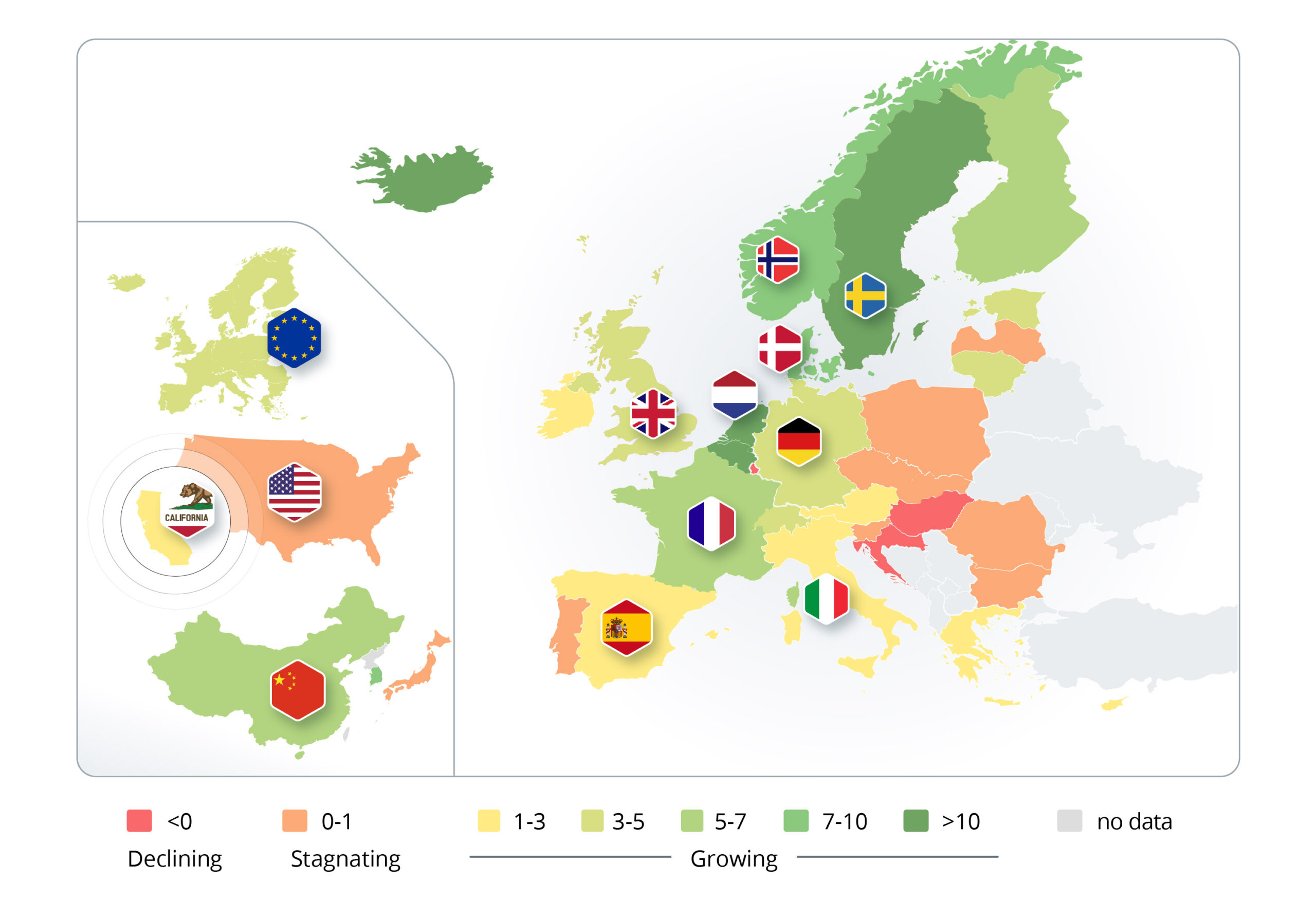
One factor driving the rise in new BEV registrations is the further expansion of the charging infrastructure (FIGURE 3). While the coverage for standard and fast charging (up to 150 kW) continues to improve, in 2023 the main focus was on expanding the network of ultra-fast charging points (150 kW and above). Ultra-fast charging enables a car battery to be charged within just a few minutes, particularly important for customers on long journeys. Ultra-fast charging points have been installed across all markets in Europe, mostly with triple-digit growth rates. The same applies to eastern Europe, even if there is still a significant gap by comparison. These developments are increasingly invalidating the argument that BEVs are unsuitable for long distances.

FIGURE 3DEVELOPMENT OF THE NUMBER OF PUBLIC CHARGING POINTS PER 10,000 RESIDENTS IN 2023 YEAR ON YEAR, BY COUNTRY
(in units)

Source: Berylls Strategy Advisors

IN 2024, COMPANIES ARE PREPARING FOR STRICTER EUROPEAN EMISSIONS TARGETS IN 2025

In 2025, the second stage of the EU law designed to reduce the CO emissions of new vehicles registered in Europe (Regulation [EU] 2019/631) will come into force. This stage requires a further 15% reduction in CO emissions for OEMs in Europe compared to the current targets. The stricter regulation will culminate in a ban on new ICE vehicles as of 2035 – despite this ambitious target being regularly called into question in the worlds of politics and business and coming up for review again in 2026.

A slight increase in new BEV registrations is therefore predicted in Europe in 2024. However, similar to the previous year, the rise is likely to remain relatively low with an expected market penetration of around 16% to 18% (15.7% in 2023). Conversely, very strong growth is expected for 2025 against the backdrop of the new European requirements for CO emissions. BEVs are expected to account for almost a quarter of new registrations in Europe in 2025.

However, to achieve this ambitious target, OEMs will need to significantly expand their BEV portfolio and make their vehicles far more attractive to buyers. For this reason, numerous new models have either already been announced (e.g., the Fiat Panda) or presented (e.g., the Citroën ë-C3, Renault 5, or Audi Q6), which will be available by the end of 2024. Particularly in the B (small car) and C (mid-range) segments, by far the most popular in Europe, the choice of models on the market will be substantially larger. Until now, there has only been a very limited and uncompetitive range of BEVs in these segments. The affordable Renault 5, Citroën ë-C3, and Fiat Panda models will be particularly relevant and available from 2025 for less than €25,000. With a reasonable range (over 300 km in accordance with WLTP), these vehicles will therefore open up a completely new market.

On the other hand, OEMs will also have to increase their BEV sales in southern and eastern European countries, which have so far only played a marginal role on the road to electrification in Europe. As new vehicle registrations in Norway are almost completely electric (over 90% share of BEV and PHEV sales in 2023), very little additional growth is expected there. Major markets such as Italy and Spain, which account for 12% and 7% of European sales respectively, will therefore have to play a greater role in the registration of new BEVs in Europe.

EUROPEANS ARE READY TO SWITCH TO BEVS, AS LONG AS THE PRICE IS RIGHT

Although the public debate on this topic is still very tense, there are numerous signs that many European consumers are willing to consider buying a BEV. Although a BEV is often still more expensive to buy than a comparable ICE, the BEV scores points in terms of total cost of ownership, as the operating costs (fuel, maintenance, etc.) are lower than those of an ICE vehicle.

The example of social leasing for low-income households in France also shows that lower costs can be a strong argument in favor of purchasing a BEV. In this case, an electric vehicle manufactured in Europe could be leased for €100 per month – and partially financed by the state government. The program was launched at the beginning of 2024 – and discontinued just one month later as the annual budget had already been exceeded, which proves there is no shortage of BEV customers, provided the offer is financially viable.

Last year, the best-selling model in Europe (and worldwide) was also a BEV: the Tesla Model Y. Above all, it has helped Tesla to catch up with highly popular car brands such as Citroën or Fiat (in terms of vehicle sales in Europe) and overtake established manufacturers such as Volvo or Nissan on the European market. The trend is confirmed when you take a look at Chinese manufacturers. For example, sales figures for manufacturers MG (SAIC) and BYD in Europe have skyrocketed, largely due to their highly competitive range of BEVs. In 2023, MG made it into the top 20 brands in Europe – a first for a Chinese brand – and its top model, the electric MG4, secured a place in the top 5 best-selling electric vehicles in Europe in 2023. This fact underlines how important it is for established manufacturers to offer a competitive range of models in Europe’s main market segments in order to avoid losing market share to new entrants.

The market is beginning to adapt to this new reality, with many manufacturers lowering the prices of their electric models (in some cases significantly) in order to position themselves more competitively on the market. This was the case with Renault and Volkswagen, for example, but also Toyota, where prices for the mid-range SUV bZ4X were reduced by €20,000 in France between mid-2023 (from €55,000 at the time) and February 2024 (from €35,000). Due to the previously far higher price, only 626 units of this vehicle were sold in France in 2023.

BEV SALES FIGURES WILL CONTINUE TO RISE – DESPITE THE GRADUAL PHASING OUT OF SUBSIDIES IN EUROPE

For some years now, the subsidies offered by European governments to encourage the purchase of BEVs have been gradually reduced as their attractiveness (price, charging infrastructure, technical maturity) increases and registration figures rise. And 2024 is no exception; in France, for example, the subsidy when purchasing a BEV has been reduced from €5,000 to €4,000. However, these reductions have so far never hindered the gradual increase in the share of BEVs in new car sales figures, as the example of Norway clearly illustrates. The Scandinavian country had previously introduced a full VAT reduction for BEVs, which was abolished as of January 1, 2023. Although this move caused the overall market share of BEVs to drop significantly in the first few months of 2023, the upward trend over the year as a whole was not reversed as a result.

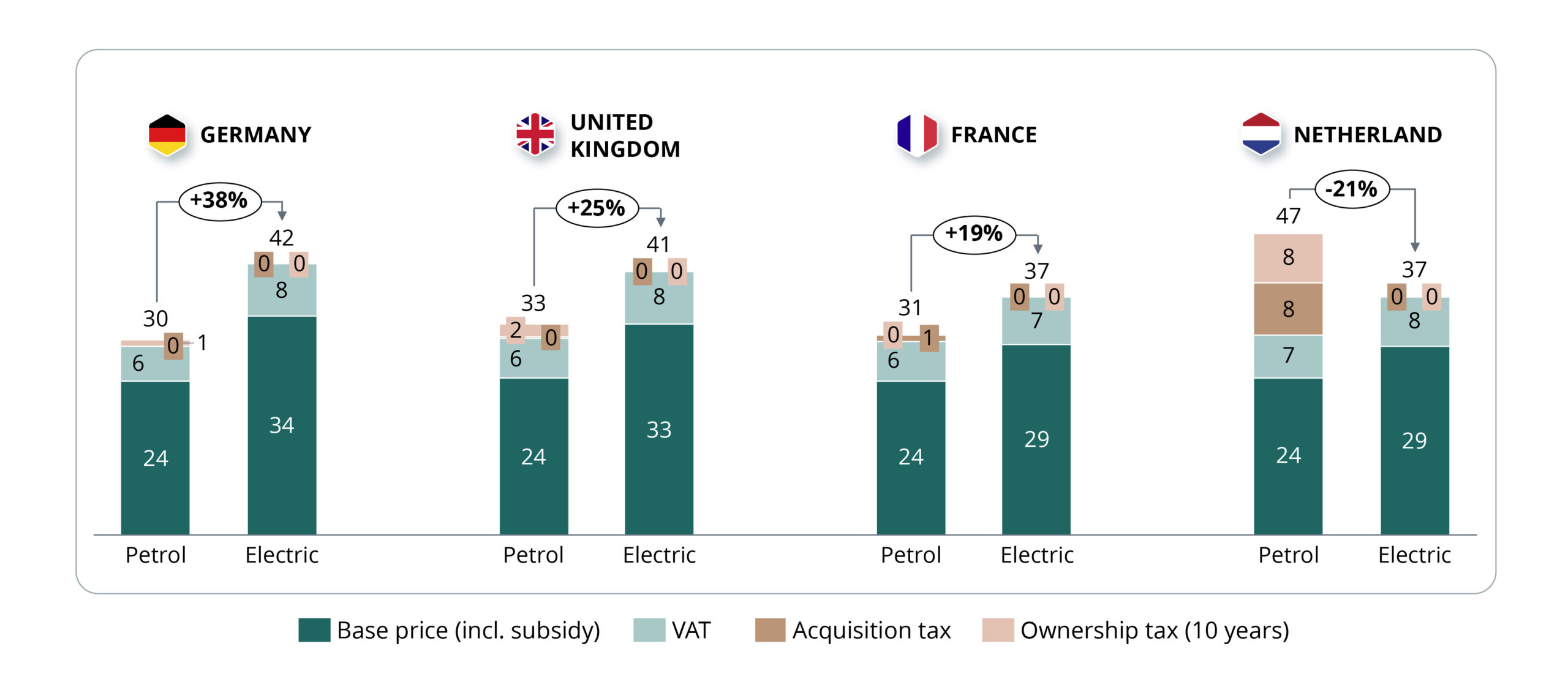
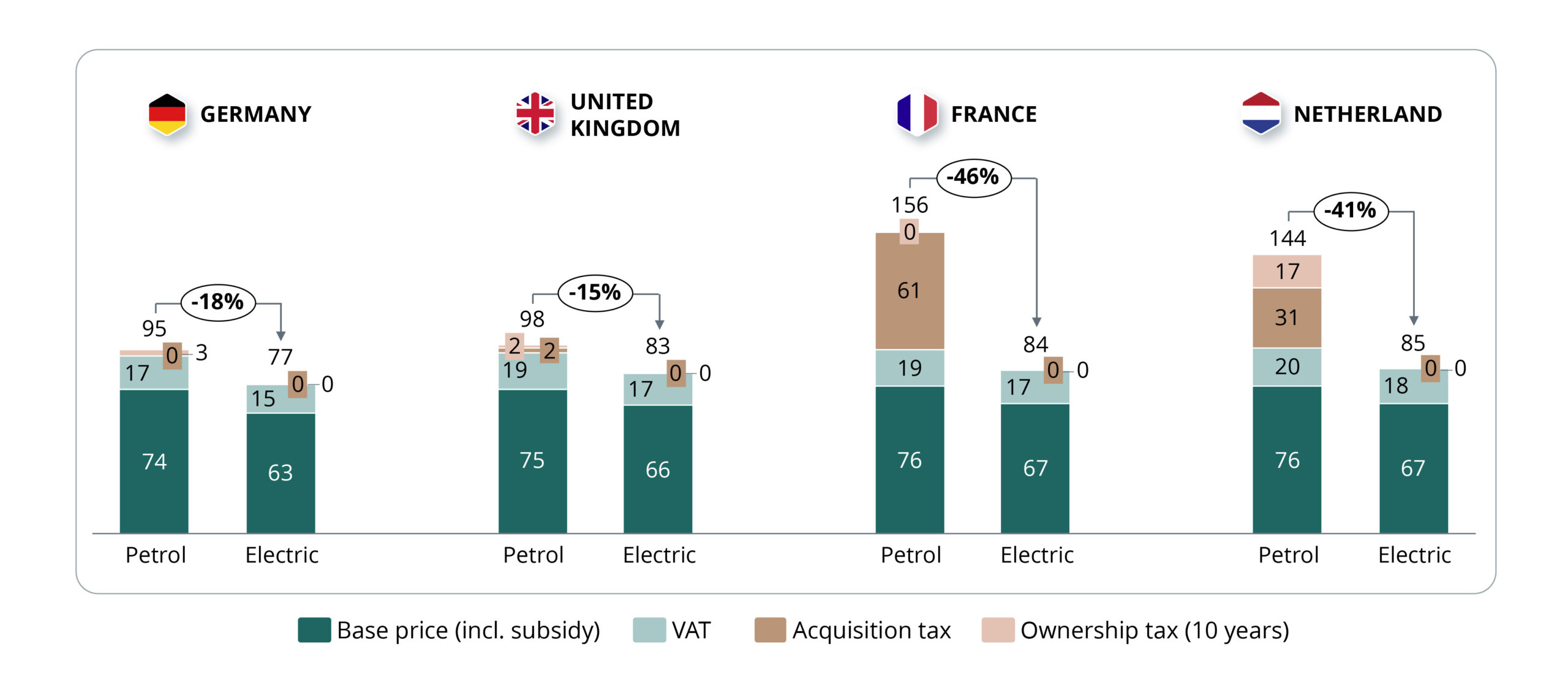
Subsidies for BEVs are a means for policymakers to increase the pace of electrification. The taxation of combustion vehicles also serves this purpose, and the subsidies are also partly financed via this method. For example, Norway, the Netherlands and, to a certain extent, France have implemented a tax system that makes the purchase of ICEs – especially those with high CO₂ emissions – far less attractive (FIGURE 4, FIGURE 5).

FIGURE 4 COST COMPARISON BETWEEN BUYING A HYUNDAI KONA (B-SUV SEGMENT) AS A BEV VERSION OR A PETROL VERSION IN SELECTED EUROPEAN COUNTRIES
(in thousands of EUROS)

Source: Berylls Strategy Advisors

For mainly external reasons (federal budget 2024), Germany abruptly discontinued its subsidy system for the purchase of BEVs at the end of 2023.
In contrast to other countries, however, there has been no corresponding adjustment or change to the tax model that would make the purchase of ICE vehicles less attractive. The combination of these two aspects means that the attractiveness of BEVs compared to ICEs has declined and, as a result, BEV sales unit figures contracted considerably in the first quarter of 2024. As the OEMs’ CO fleet targets are at stake, OEMs in Germany must potentially offer higher discounts in order to make their BEVs attractive again and partially compensate for the expiry of the environmental subsidies. That is far easier with premium models, as the margins are highest in this market segment and the price difference to an ICE vehicle is much smaller – sometimes even to the advantage of the comparable BEV model (FIGURE 5).

FIGURE 5COST COMPARISON BETWEEN BUYING A BMW X5 / iX (E-SUV SEGMENT) AS A BEV VERSION AND A PETROL VERSION IN SELECTED EUROPEAN COUNTRIES
(in thousands of EUROS)

Source: Berylls Strategy Advisors 

The discontinuation of subsidies will mainly affect private customers, as the tax benefits for electric company cars will be maintained (or even expanded, taking into account the increase in the upper price limit for the reduced tax rate to 0.25%). As company cars account for 60% of the German car market (compared to 20% in France, for example), that should at least partially mitigate any potential decline in BEV sales in 2024. OEMs are therefore well advised to make attractive BEV offers and highlight them, especially when it comes to company car leasing.

THE EXPANSION OF CHARGING INFRASTRUCTURE IN EUROPE CONTINUES – AND THE TREND IS GAINING PACE

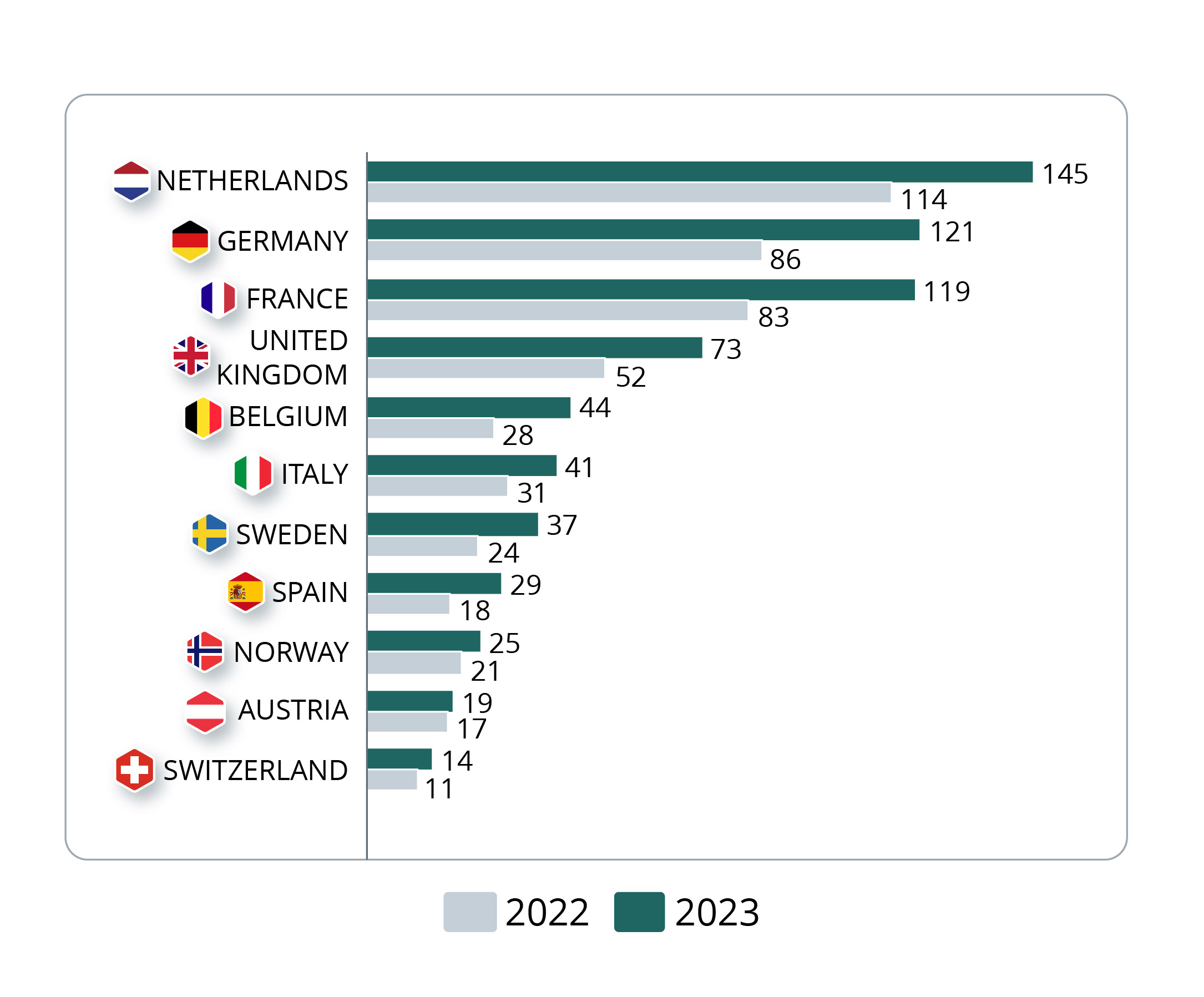
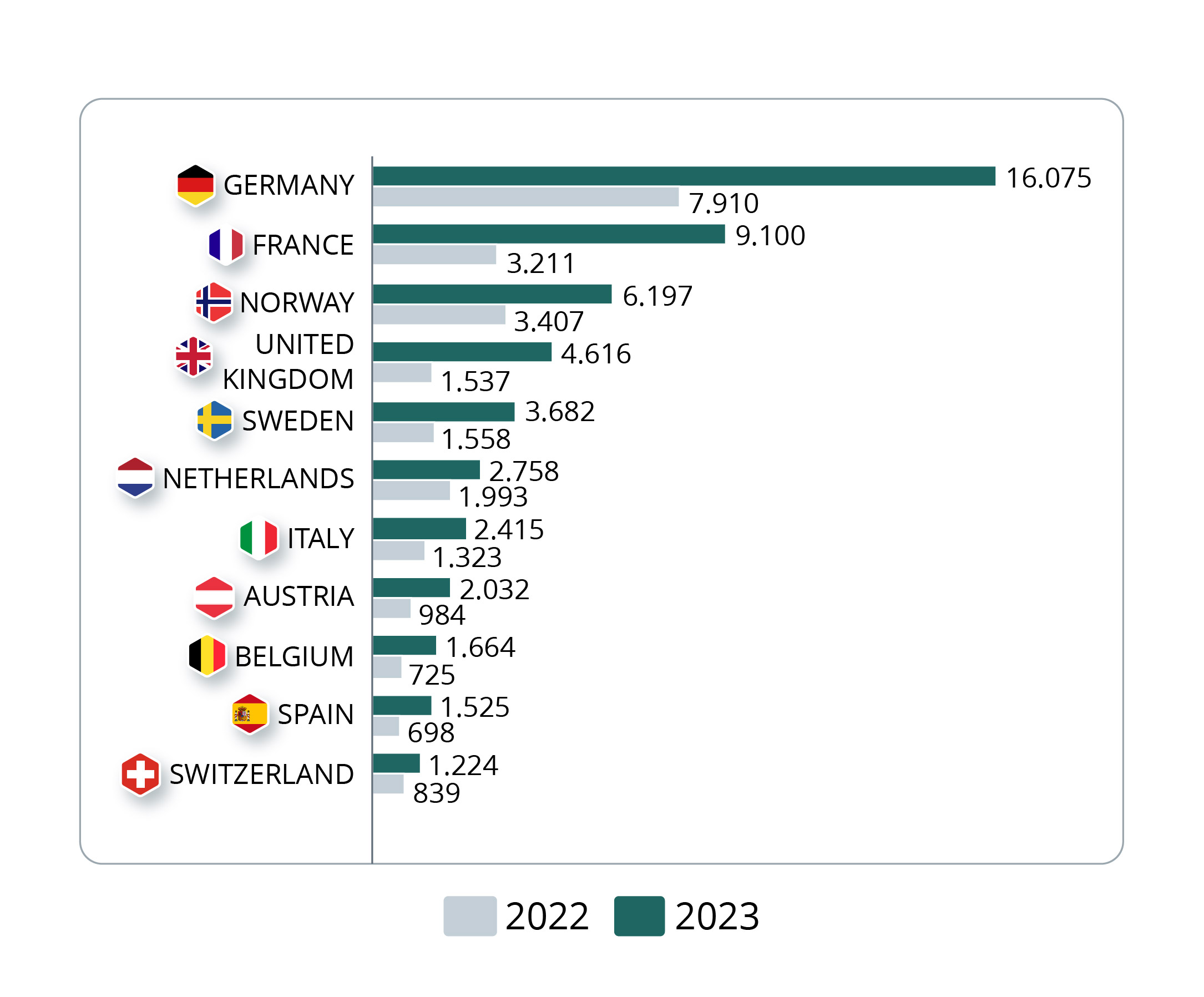
Charging infrastructure is dependent on long-term investments and less subject to fluctuations in the automotive market. Apart from the 38% increase in the overall number of charging points in Europe last year (FIGURE 6), the doubling (+110%) of ultra-fast charging points (150 kW and above) illustrates the current degree of momentum in Europe (FIGURE 7).

FIGURE 6 DEVELOPMENT OF THE NUMBER OF PUBLIC CHARGING POINTS IN 2023 YEAR ON YEAR, BY COUNTRY
(in thousands)

Source: Berylls Strategy Advisors

FIGURE 7 – DEVELOPMENT IN THE NUMBER OF PUBLIC ULTRA-FAST CHARGING POINTS (150 KW AND ABOVE) IN 2023 YEAR ON YEAR, BY COUNTRY
(in units)

Source: Berylls Strategy Advisors

The trend is unlikely to lose pace in 2024 or even beyond, as numerous investments have already been announced, often combined with state or European funding. The EU is supporting the development of charging infrastructure with its AFIR law, which requires the member states to fulfill two conditions: firstly, to ensure a certain installed capacity per electric vehicle registered in the country (1.3 kW per BEV and 0.8 kW per PHEV), and secondly, to guarantee minimum coverage along the main transport routes with ultra-fast charging points (one charging station of at least 150 kW per 60 km in the European “Core TEN-T Network” by 2025). The aim of the first condition is to maintain the pressure on EU member states so that the infrastructure can be expanded at a sufficient rate to meet the needs of the ever-growing fleets of BEVs in future years. At present, all EU states except Malta meet this criterion. The second condition is aimed at stepping up the development of a sufficiently fast infrastructure to enable convenient long-distance travel throughout Europe – a matter that can currently still be a problem in some eastern European countries.

Many charging network operators as well as energy suppliers and oil companies are either in the process of entering this dynamic market or increasingly investing in it. Mercedes-Benz Mobility, for example, entered the ultra-fast charging market last year, while Total Energies fully converted some of its petrol stations into charging stations for electric vehicles in 2023 – taking a further step on its journey from being simply an oil company to an energy supplier. The rapidly growing market requires high levels of investment to expand the infrastructure, which will, however, only pay off at a later date. The many new players need to invest a great deal at the moment in order to play a role in this highly promising market in the future. However, it is not yet large enough for the companies to be profitable, which means the market is inevitably heading for consolidation. 

Insight download and author information

Authors

Dr. Alexander Timmer

Partner

Valentin Froh

Project Manager

Dennis Koschmieder

Consultant

Dr. Alexander Timmer

Dr. Alexander Timmer (1981) joined Berylls by AlixPartners (formerly Berylls Strategy Advisors), an international strategy consultancy specializing in the automotive industry, as a partner in May 2021. He is an expert in market entry and growth strategies, M&A and can look back on many years of experience in the operations environment. Dr. Alexander Timmer has been advising automotive manufacturers and suppliers in a global context since 2012. He has in-depth expert knowledge in the areas of portfolio planning, development and production. His other areas of expertise include digitalization and the complex of topics surrounding electromobility.
Prior to joining Berylls Strategy Advisors, he worked for Booz & Company and PwC Strategy&, among others, as a member of the management team in North America, Asia and Europe.
After studying mechanical engineering at RWTH Aachen University and Chalmers University in Gothenburg, he earned his doctorate in manufacturing technologies at the Machine Tool Laboratory of RWTH Aachen University.

Quo Vadis, China 2024 – A rat race with no end in sight

Munich, February 2024
2

023 was a highly turbulent year for the Chineseauto market, which saw it engulfed in a viciouscircle – a “rat race” with no end in sight and pricewars as the weapons of choice.

In the following insight report, we want to explore this rat race in greater detail and provide an outlook for 2024, including the challenges that lie ahead as well as the focal points of foreign OEMs in the highly complex Chinese market.

RECAP 2023

“卷” or the involution of the Chinese auto market Overall performance

The term “卷” (spelled “Juǎn” in Chinese Pinyin) was undoubtedly the prevailing expression in the Chinese automotive market in 2023. It is understood to mean “involution” or “rat race,” depicting a scenario in which all market participants are entangled in an intense battle for market share with no foreseeable conclusion.

And that exactly describes the Chinese auto market with the emergence of a price war as the ultimate solution, while favorable governmental subsidies are on the way out – a vicious circle

Curious? Download the full insight now!

Insight download and author information

Berylls Insight

Quo Vadis China 2024 - A rat race with no end in sight
DOWNLOAD

Authors

Dr. Jan Burgard

Berylls Group CEO

Willy Wang

Managing Director China

Lois Yang

Consultant

Dr. Jan Burgard

Dr. Jan Burgard (1973) is CEO of Berylls Group, an international group of companies providing professional services to the automotive industry.

His responsibilities include accelerating the transformation of luxury and premium OEMs, with a particular focus on digitalization, big data, connectivity and artificial intelligence. Dr. Jan Burgard is also responsible for the implementation of digital products at Berylls and is a proven expert for the Chinese market.

Dr. Jan Burgard started his career at the investment bank MAN GROUP in New York. He developed a passion for the automotive industry during stopovers at an American consultancy and as manager at a German premium manufacturer. In October 2011, he became a founding partner of Berylls Strategy Advisors. The top management consultancy was the origin of today’s Group and continues to be the professional nucleus of the Group.

After studying business administration and economics, he earned his doctorate with a thesis on virtual product development in the automotive industry.

Willy Wang

Willy Lu Wang (1981) joined Berylls Strategy Advisors in 2017. He started his career participating in the graduate program of Audi focusing on production planning. After stations at another strategy consultancy as well as being the strategy director for a German Tier-1 supplier, he is now responsible for the China business at Berylls.

He has a broad consulting focus working for all clients in China, whether they are JVs, WOFEs or pure local players. He is also responsible for the development of AI and Big Data products dedicated towards the Chinese market further strengthening the Berylls End-to-End strategy and product development capabilities.

Wang studied Electronics & Information Technology with focus on Systems and Software Engineering and Control Theory at Karlsruhe Institute of Technology.

Podcast: Die Basis der deutschen Automobilbranche ist super

München, Dezember 2023

Wie geht es unseren Zulieferern? Wie unterscheiden sich die Strategien der Hersteller? Funktioniert das vielfach angestrebte Agenturmodell im Zusammenspiel der OEMs und Händler? Kann man wirklich mit digitalen Services Geld verdienen? Und: ist die Intermodalität am Ende?

Darüber sprechen Jürgen Stackmann und Dr. Jan Burgard in der neuesten Mobility Pioneers #Podcast Folge.

Jetzt reinhören!

Hier gehts zum Podcast

Insight download and author information

Autor

Dr. Jan Burgard

CEO Berylls Group

Dr. Jan Burgard

Dr. Jan Burgard (1973) ist CEO der Berylls Group, einer internationalen und auf die Automobilitätsindustrie spezialisierten Unternehmensgruppe.
Sein Aufgabengebiet umfasst die Transformation von Luxus- und Premiumherstellern, mit besonderen Schwerpunkten auf Digitalisierung, Big Data, Start-ups, Connectivity und künstliche Intelligenz. Dr. Jan Burgard verantwortet bei Berylls außerdem die Umsetzung digitaler Produkte und ist ausgewiesener Spezialist für den Markt China.
Dr. Jan Burgard begann seine Karriere bei der Investmentbank MAN GROUP in New York. Die Leidenschaft für die Automobilitätsindustrie entwickelte er während Zwischenstopps bei einer amerikanischen Beratung und als Manager eines deutschen Premiumherstellers.
Im Oktober 2011 komplettierte er die Gründungspartner von Berylls Strategy Advisors. Die Top-Management-Beratung ist die Basis der heutigen Group und weiterhin der fachliche Nukleus aller Einheiten.
An das Studium der Betriebs- und Volkswirtschaftslehre, schloss sich die Promotion über virtuelle Produktentwicklung in der Automobilindustrie an.

Five battles you must win as an OEM to master Pricing & Revenue Management

Munich, October 2023
T

he transformation of the automotive industry is in full swing, encompassing both upstream and downstream aspects on national and international scales.

To paint a clear picture of this evolution, various aspects of the automotive sector are being reshaped. New strengths are being cultivated, weaknesses are being addressed.

A critical aspect deserving focused attention is “Pricing and Revenue Management.”

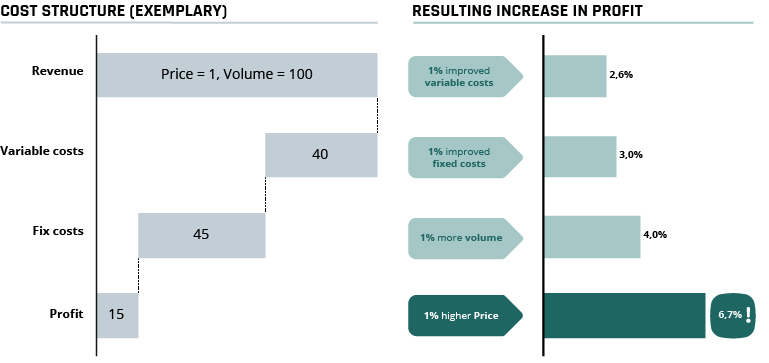
Fig 1: Pricing as the Ultimate Profit Lever

Source: Berylls Strategy Advisors

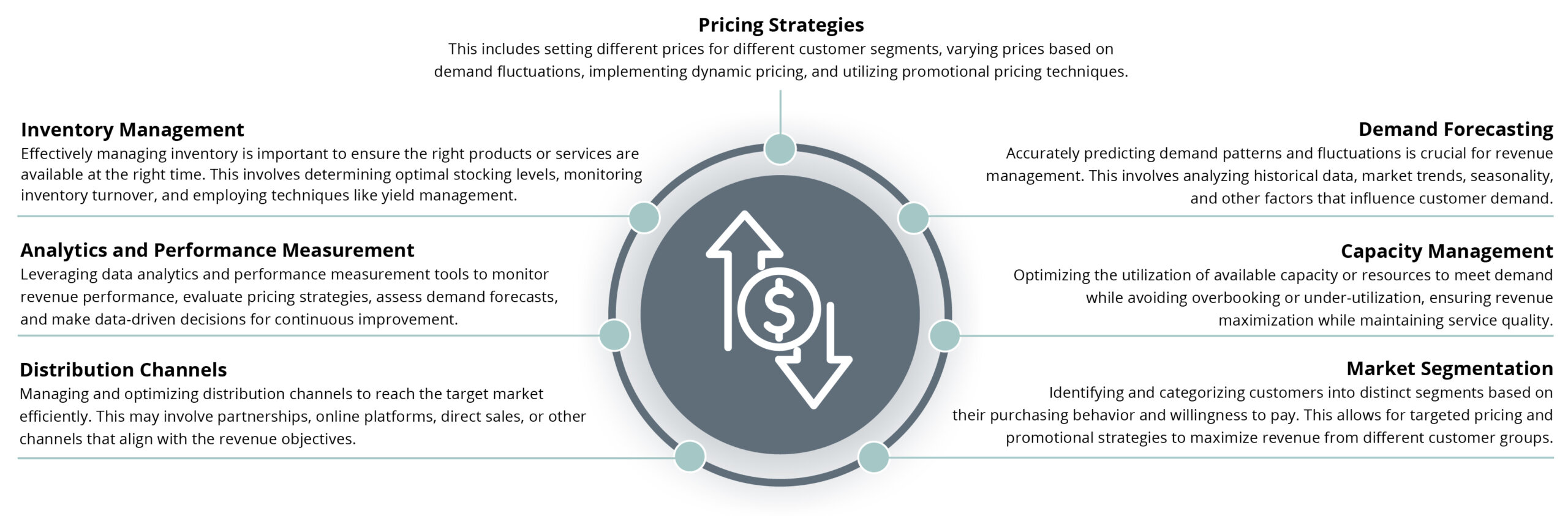
Pricing stands as the most potent lever for increasing profitability within the automotive sector. Consequently, it should take center stage for all Original Equipment Manufacturers (OEMs). However, it’s essential to recognize that Revenue Management extends beyond Pricing. It involves a strategic business practice adopted by companies to maximize their revenue and profitability through the optimization of product or service pricing. This discipline entails the application of diverse pricing strategies, data analysis, and forecasting techniques to make informed decisions about price setting, resource allocation, and capacity management. The primary components are depicted in the chart below. Pricing emerges as the most significant lever for enhancing profitability, making it of utmost importance for top management.

Fig 2: Revenue Management Encompasses Multifaceted Strategies

Source: Berylls Strategy Advisors

With a number of years of experience across various industries, it is evident that the automotive sector can glean valuable insights and techniques in Pricing and Revenue Management from sectors such as Fast-Moving Consumer Goods (FMCG), software, and industrial fields. Currently, many OEMs are still focusing a lot on factory utilization. This can result in cars being sold with higher discounts, because production and demand are not matching good enough. Many changes occurring in the automotive industry mirror transformations witnessed by other industries in recent years:

  • From Product to Product-Service-Software Combinations: The significance of services and software is growing, necessitating different pricing structures, and enabling novel approaches such as “as-a-service.”

  • From Single- to Omnichannel: Vehicles, services, and software will be sold through an expanding array of channels, including direct and indirect, electronic, and physical, and owned or third-party channels. Decisions regarding what to sell through which channel to which customer segment at what price are becoming more intricate and, thus, more strategically crucial.

  • From Product to Customer Focus: OEMs are increasingly striving to better comprehend their customers (their journey, value drivers, willingness to pay, etc.). This understanding provides a solid foundation for more differentiated pricing, better exploitation of specific customer segments’ willingness to pay, and catering to individual demands for products and services.

  • From Gut Feeling to Data-Based: Modern Revenue Management can be approached much more professionally using data and AI-based methods.


Considering these ongoing transformations, now is the ideal time to formulate and implement a 3-5-year development plan to fortify the Pricing & Revenue Management capabilities.

Best practices from Other Industries

Before delving into the specific must-win-battles (MWBs) for Pricing & Revenue Management in the automotive sector, let’s explore some best practices from other industries:

  • Marriott International: Renowned for its revenue management strategies in the hospitality industry, Marriott employs sophisticated pricing algorithms and data analytics to dynamically adjust room rates based on demand, seasonality, and other factors. This optimization maximizes revenue and occupancy rates across its global portfolio of hotels.

  • Amazon: As one of the world’s largest e-commerce companies, Amazon excels in revenue management through its advanced pricing strategies. They leverage extensive customer data to dynamically adjust prices on their marketplace, optimizing in real-time while considering factors such as competitor pricing, demand, and customer behavior.

  • Walt Disney Parks and Resorts: Disney meticulously practices revenue management within its theme parks. They employ various pricing strategies, including seasonal pricing, tiered ticketing, and add-on experiences, to optimize revenue and manage crowd levels effectively.

  • Ferrero: With its diverse brands and sales channels, Ferrero has implemented professional Revenue Management on a global scale. Based on a clear governance, well-defined playbooks and extensive data utilization, Ferrero has achieved significant profitability gains.

Initial Conclusions

Considering these examples, let’s draw some initial conclusions:

1. Pricing & Revenue Management serves as the most substantial profit lever.

2. When benchmarked against other industries, there is ample room for improvement in automotive OEMs.

3. The ongoing developments within the automotive industry underscore the rising importance of Pricing & Revenue Management.

Consequently, we strongly advocate a concentrated focus on Pricing & Revenue Management, with particular emphasis on the following 5 must-win-battles (MWBs):

MWB 1 – Establish a Clear Pricing & Revenue Management Strategy

A robust strategy is fundamental to success, and this holds true for Pricing & Revenue Management. Given the complexity of the automotive environment, the strategy must provide detailed answers to critical strategic questions. These include prioritizing revenue over profitability (or vice versa?), setting objectives for each Strategic Business Unit (SBU), defining target customers, understanding their value drivers and willingness to pay, positioning prices, determining channel strategies for different customer segments, and specifying pricing methods.

Developing a Pricing & Revenue Management strategy for an automotive OEM is a comprehensive exercise that necessitates in-depth insights into and transparency about markets, customers, channels, and offerings, both internally and externally. Of course, it must be mentioned that OEMs are not starting from scratch but have already developed elements or even entire Pricing & Revenue Management strategies.

MWB 2 – Implement a Target Operating Model for Pricing & Revenue Management

Determining the organizational structure of Pricing & Revenue Management is crucial. It’s essential to decide whether the team should be centralized, decentralized, or a hybrid model. This decision should align with the overall strategy and objectives of Pricing & Revenue Management. As always, there´s not THE one solution that is always right:

  • Apple and Skype are having centralized pricing teams because they have strong global brands and high price transparency.*

  • Porsche and Michelin use a split responsibility to foster a high degree of standardization on the one hand side. At the same time, local input e.g., to differentiate local willingness to pay must be considered.*

  • At 3M and Celesio, the Pricing teams are largely decentral with responsibility for a BU or region. This makes sense because markets are heterogeneous with different regulatory requirements for example.*

*Please note that this may not correspond to the current status of the companies.

In addition to structure, harmonizing global Pricing & Revenue Management processes is crucial for automation through digitization. Technology and human resources are integral components of the Target Operating Model. As the era of direct sales is coming closer, this of particular importance, as from than on, the final pricing responsibility stays with the OEM.

MWB 3 – Understand Customer Willingness to Pay and Set Prices Accordingly

A central tenet of Pricing & Revenue Management is understanding customers and aligning strategies accordingly. Effective Pricing & Revenue Management involves precise tools and concepts, with price differentiation being a significant component. Many companies successfully charge different prices to different customer segments for the same product or service, based on willingness to pay. Other industries are already successfully doing this as we speak: Just consider the practice that hotels and airlines are applying very successfully since many years. Amazon is changing the price for certain products up to 40 times a day, based on demand, competitor prices etc. Big insurance companies offer their insurance products at differentiated prices to different customers. Automotive has made recent experience with changing willingness to pay during the time of product shortages. Customers that are used to negotiating prices with their dealer where suddenly ready to even pay way above list price as for example visible in the United States. As product shortages are more and more dissolving now, the old pattern of price negotiation is coming back. A lot more examples of price differentiation exist.

To achieve this successfully, OEMs must understand the willingness to pay of their target customer segments, employing various reliable techniques for this purpose. This not only boosts profitability but also enhances revenue. And always remember that a 1% price increase already leads to a 7% increase in profitability.

MWB 4 – Establish Transparency in Pricing & Revenue Management Performance

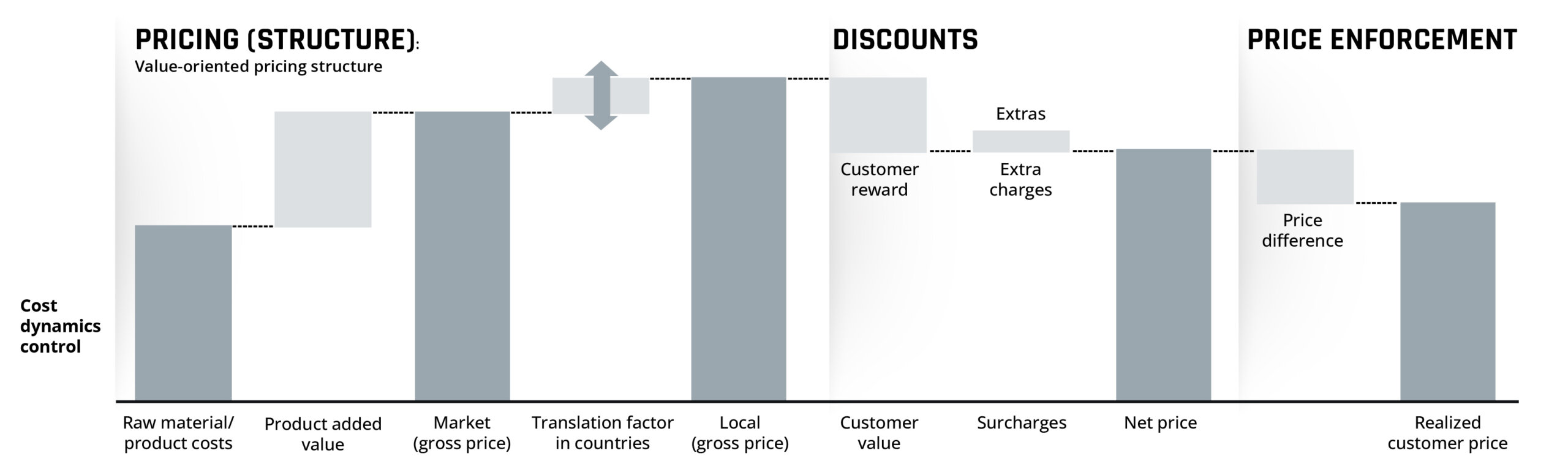
Effective Performance Management hinges on knowing the right performance metrics, measuring, and reporting them accurately, and having sound performance management processes in place. Performance metrics vary based on business models, and achieving granularity across different business, customer, and product segments is often necessary. When list prices exist and discounts and rebates can be granted, you might want to use “price enforcement” as one top KPI. When you are for example in an online business, where prices are set by an AI-algorithm, a suitable KPI can be “realized price improvement”, measuring the price increase over a certain period. To add even more quality, “realized price improvement” can be measured against a market price index or internal objectives. The price waterfall can be a good input to discuss suitable KPIs. For OEMs on their way to the direct sales mode, managing price enforcement will be one of the key capabilities to be built to ensure profitability targets are met.

Fig 3: Price waterfall as food-for-thoughts about pricing KPIs.

Source: Berylls Strategy Advisors

Performance metrics should align with the pricing strategy and objectives, and data should be made available in suitable reports, despite the challenges of legacy IT systems and data quality.

MWB 5 – Leverage Data and AI to Optimize Pricing & Revenue Management

Data and AI offer tremendous potential for enhancing Pricing & Revenue Management. Using AI, OEMs can optimize various facets of Revenue Management simultaneously, which is challenging with conventional methods. Additionally, understanding customer behavior and preferences from data can guide pricing strategies and offerings. However, successfully scaling AI projects in Pricing & Revenue Management requires investment in relevant data, systems, and expertise, as data quality and system readiness are often limiting factors.

Conclusion

In conclusion, while automotive OEMs may not be considered Pricing & Revenue Management benchmarks compared to other industries, the changing landscape demands attention. We recommend that OEMs assess their current maturity level in Pricing & Revenue Management and chart a strategic roadmap, centered around these 5 must-win-battles outlined in this paper. With the Berylls Pricing Pathfinder we combine our Pricing & Revenue Management expertise with a powerful tool to reveal what Pricing & Revenue Management excellence looks like, and how to get there.

Insight download and author information

Author

Thorsten Lips

Partner

Thorsten Lips

Thorsten Lips (1972) is a partner at Berylls by AlixPartners (formerly Berylls Strategy Advisors). He began his career as a management consultant at PricewaterhouseCoopers Düsseldorf in 1998. After spending six years at Malik Management Centre in St. Gallen, Switzerland, he took the cross-industry, global responsibility for Pricing, Sales, Service and Marketing as a partner at Horváth. At Berylls, his area of expertise is Pricing & Revenue Management. This encompasses classical topics like new- and used-car pricing, aftersales pricing and the like. In addition, he is an expert in innovative Pricing and Revenue Management approaches for digital products and services as well as in the field of data-driven Pricing.

Industrial engineering and management studies at the Technical University of Ilmenau and the Technical University of Darmstadt.

Semi-annual index rebalancing: WidsomTree Berylls LeanVal global automotive innovators index

Munich, October 2023
F

ew things shape modern life as much as individual mobility. Be it as an expression of freedom and individuality, or as an economic driver. 

To reflect this, we have developed the WisdomTree Berylls LeanVal Global Automotive Innovators Index – the WTCAR. It tracks the performance of the 100 most relevant publicly listed automobility players worldwide.

By design, the WTCAR covers the industry’s entire value chain – from vehicle manufacturers and suppliers, to dealer groups, and providers of mobility services or infrastructure.

Rebalancing updates

The automotive industry experienced a severe blow from the capital markets in 2022, and the recent decline in stock prices has wiped out most of the gains that the sector had made from the pandemic lows.

Now, there are still several major effects impacting the global capital markets. First, central banks remain committed to fighting inflationary pressures and have incrementally raised interest rates as a strategic countermeasure over the past months, slowing down the recovery of the economy. Second, supply shortages caused by the Covid-19 crisis is continuously moving into the rear-view mirror, allowing for a more opti- mized production utilization. Third, political influences like the Inflation Reduction Act in the US, the war in the Ukraine, and the pressures bet- ween China and Taiwan are continuing to influence the developments at the global capital markets.

Insight download and author information

Berylls Insight

Semi-annual index rebalancing: WidsomTree Berylls LeanVal Global automotive innovators index
DOWNLOAD

Authors

Dr. Jan Burgard

Berylls Group CEO

Malte Broxtermann

Associate Partner

Björn Simon

Senior Consultant

Jakob Rüchardt

Consultant

Dr. Jan Burgard

Dr. Jan Burgard (1973) is CEO of Berylls Group, an international group of companies providing professional services to the automotive industry.

His responsibilities include accelerating the transformation of luxury and premium OEMs, with a particular focus on digitalization, big data, connectivity and artificial intelligence. Dr. Jan Burgard is also responsible for the implementation of digital products at Berylls and is a proven expert for the Chinese market.

Dr. Jan Burgard started his career at the investment bank MAN GROUP in New York. He developed a passion for the automotive industry during stopovers at an American consultancy and as manager at a German premium manufacturer. In October 2011, he became a founding partner of Berylls Strategy Advisors. The top management consultancy was the origin of today’s Group and continues to be the professional nucleus of the Group.

After studying business administration and economics, he earned his doctorate with a thesis on virtual product development in the automotive industry.

Malte Broxtermann

Malte is an expert in the development and implementation of automotive digitization strategies.

He focuses on helping clients scale (generative) artificial intelligence to improve their bottom line across the entire automotive value chain. His primary customers are automotive manufacturers and their suppliers, especially those active in the Software-Defined-Vehicle space.

Before his time at Berylls by AlixPartners (formerly Berylls Strategy Advisors), he advised leading North American utility companies. Prior to that, he saved lives as emergency medical technician. Malte holds master’s degrees in economics from Maastricht University and Queen’s University in Canada.

Ein Elektrofahrzeug ist wesentlich einfacher zu bauen als ein Verbrennungsfahrzeug

München, September 2023

Nach der diesjährigen IAA ist klar: “Wir befinden uns in einem gesättigten Markt, nur das Elektrosegment wächst. Daher ergibt es Sinn, die vergleichbaren, elektrischen, Fahrzeuge für die Kunden zur Verfügung zu stellen. Das Problem der über 300 (!) Herstellen von Elektroautos alleine in China ist: Die meisten sind nicht nur bei uns vollkommen unbekannt.“

Auch dadurch dass die Produktion einfacher ist, als bei einem Verbrenner, versuchen unzählige Marken weltweit sich einen Namen zu machen. Ein Problem – auch für Anleger, die mit einem „zweiten Tesla“ den Lucky Punch suchen. Könnte ein ETF auf den WisdomTree Global Automotive Innovators Index helfen?

Hier gehts zum Podcast

Insight download and author information

Autor

Dr. Jan Burgard

CEO Berylls Group

Dr. Jan Burgard

Dr. Jan Burgard (1973) ist CEO der Berylls Group, einer internationalen und auf die Automobilitätsindustrie spezialisierten Unternehmensgruppe.
Sein Aufgabengebiet umfasst die Transformation von Luxus- und Premiumherstellern, mit besonderen Schwerpunkten auf Digitalisierung, Big Data, Start-ups, Connectivity und künstliche Intelligenz. Dr. Jan Burgard verantwortet bei Berylls außerdem die Umsetzung digitaler Produkte und ist ausgewiesener Spezialist für den Markt China.
Dr. Jan Burgard begann seine Karriere bei der Investmentbank MAN GROUP in New York. Die Leidenschaft für die Automobilitätsindustrie entwickelte er während Zwischenstopps bei einer amerikanischen Beratung und als Manager eines deutschen Premiumherstellers.
Im Oktober 2011 komplettierte er die Gründungspartner von Berylls Strategy Advisors. Die Top-Management-Beratung ist die Basis der heutigen Group und weiterhin der fachliche Nukleus aller Einheiten.
An das Studium der Betriebs- und Volkswirtschaftslehre, schloss sich die Promotion über virtuelle Produktentwicklung in der Automobilindustrie an.

Model Based Systems Engineering in Truck R&D

Munich, September 2023
T

he trucking industry is currently grappling with significant pressure induced by an ongoing transformation predicated on three fundamental changes to its long-standing operations.

Download the full insight now.

Insight download and author information

Berylls Insight

Model based systems engineering in truck R&D
DOWNLOAD

Authors

Steffen Stumpp

Associate Partner

Frederik Ruhm

Associate Partner

Steffan Lemke

Consultant

Steffen Stumpp

Steffen Stumpp (1970) joined the Berylls Group in October 2020 as Head of Business Unit Commercial Vehicles. At this point, he already looked back on extensive professional and leadership experience in the commercial vehicle industry. Stumpp started his career in an OEM and went through different roles in research, marketing, product planning and after-sales service. When he switched to the automotive supplier industry, he took over the responsibility for worldwide sales and marketing of a medium-sized tier 1 supplier. After another step as head of sales he decided to join Berylls, where he is now responsible for the commercial vehicle business.

Stumpp is a graduate engineer and has studied industrial engineering at the KIT in Karlsruhe and the Technical University of Berlin with focus on logistics.

TOP 100-Zuliefererstudie 2023

Munich, August 2023
D

ie Zuliefererindustrie 2022 war geprägt von Sonderfaktoren wie dem Krieg in der Ukraine, steigender Inflation und weiterhin hohen Rohstoffpreisen.

Obwohl 95 der Top 100 Zulieferer im Geschäftsjahr 2022 steigende Umsätze verzeichnen, schrumpft die Profitabilität bei mehr als der Hälfe. Nach einem Gesamtumsatz von 899 Milliarden Euro in 2021 steigerten die Top 100 dieses Resultat um 18,3 Prozent auf 1.064 Milliarden Euro und durchbrechen damit erstmals die Schallmauer von einer Billion Euro Umsatz. 

Der Beitrag der chinesischen Zulieferer an der internationalen Umsatzentwicklung steigt stetig. Im Jahr 2018 lag er noch bei fünf Prozent, 2022 können die Chinesen bereits einen neunprozentigen Anteil für sich verbuchen. Der Zuwachs geht zu Lasten der deutschen und japanischen Zulieferer. Deutschland war am Gesamtumsatz 2018 mit stolzen 23 Prozent beteiligt, Japan steuerte 28 Prozent bei. Beide Nationen verzeichnen seither schmerzhafte Rückgänge. Die deutschen Zulieferer tragen nur noch 21 Prozent zum globalen Gesamtumsatz der Branche bei, die Japaner 22 Prozent. 

Dass 2022 ein gemischtes Jahr für die Branche war, zeigt sich auch darin, dass trotz starkem Umsatzwachstum die durchschnittliche Profitabilität von 6,3 Prozent auf 5,6 Prozent gefallen ist. Höhere Materialkosten, Unruhen in den Lieferketten und gestiegene Energiekosten werden voraussichtlich auch noch bis in das nächste Jahr reichen. Auf der anderen Seite sind Halbleiterhersteller die klaren Gewinner. Die drei profitabelsten Unternehmen sind in diesem Jahr allesamt in dieser Branche tätig. Und: Auch 2022 gab die allgegenwärtige Elektromobilität die Richtung vor.

Aber sehen Sie selbst!

Weitere Informationen zur jährlichen TOP 100-Zuliefererstudie finden Sie unter www.berylls.com/category/top-100/

Berylls Insight

Die TOP 100-Zuliefererstudie 2023
DOWNLOAD

Autoren

Dr. Alexander Timmer

Partner

Dr. Jan Dannenberg

Executive Partner

Dr. Jürgen Simon

Associate Partner

Dr. Alexander Timmer

Dr. Alexander Timmer (1981) ist seit Mai 2021 als Partner bei Berylls by AlixPartners (ehemals Berylls Strategy Advisors) tätig, einer internationalen und auf die Automobilitätsindustrie spezialisierten Strategieberatung. Er ist Experte für Markteintritts- und Wachstumsstrategien, M&A und kann auf eine langjährige Erfahrung im Operations-Umfeld zurückschauen. Dr. Alexander Timmer berät seit 2012 Automobilhersteller und -zulieferer im globalen Kontext. Er verfügt über ein fundiertes Expertenwissen in den Bereichen Portfolioplanung, Entwicklung und Produktion. Zu seinen weiteren fachlichen Schwerpunkten zählen unter anderem Digitalisierung und der Themenkomplex rund um die Elektromobilität.
Vor seinem Einstieg bei Berylls Strategy Advisors war er unter anderem für Booz & Company und PwC Strategy& als Mitglied der Geschäftsführung in Nordamerika, Asien und Europa tätig.
Im Anschluss an sein Maschinenbaustudium an der RWTH Aachen und der Chalmers University in Göteborg promovierte er im Bereich der Fertigungstechnologien am Werkzeugmaschinenlabor der RWTH Aachen.

Dr. Jan Dannenberg

Dr. Jan Dannenberg (1962) ist seit 1990 Berater der Automobilindustrie und seit Mai 2011 Gründungspartner bei Berylls Strategy Advisors. Bis zum Frühjahr 2011 war er acht Jahre international als Partner – davon fünf Jahre als Associate Partner – für Mercer Management Consulting und Oliver Wyman tätig. Er ist ausgewiesener Spezialist für Innovationen und Markenmanagement in der Automobilindustrie und berät im Schwerpunkt Zulieferer und Investoren zu Strategie, Mergers & Acquisitions und Performance Improvement. Zudem ist er Geschäftsführer von Berylls Equity Partners, eine auf Mobilitätsunternehmen spezialisierte Beteiligungsgesellschaft.

Bachelor of Arts in Volkswirtschaftslehre von der Stanford University, Studium der Betriebswirtschaftslehre und Promotion an der Universität Bamberg.

Dr. Jürgen Simon

Dr. Jürgen Simon (1986) ist als Associate Partner bei Berylls by AlixPartners (ehemals Berylls Strategy Advisors) tätig, einer internationalen und auf die Automobilitätsindustrie spezialisierten Strategieberatung. Er ist Experte für Vertriebs- und Unternehmensstrategien sowie M&A und kann auf eine langjährige Beratungserfahrung zurückschauen. Er berät seit 2011 Automobilhersteller und -zulieferer und verfügt über fundiertes Expertenwissen in den Bereichen ganzheitliche Strategieentwicklung, Geschäftsmodelle und Commercial Due Diligence. Weitere Schwerpunkte liegen in Markteintrittsstrategien sowie Themen rund um das „Software Defined Vehicle“. Als diplomierter Ökonom der Universität Hohenheim hat er vor seinem Einstieg bei Berylls am Institut für Unternehmensführung des Karlsruher Instituts für Technologie (KIT) promoviert.

Digital Automotive Commerce: Creating Web 3.0 experiences and strategy from business to implementation

Munich, August 2023
A

pple's newest Vision Pro is here and brings with it the promise of reinvigorated momentum in immersive Web 3.0 applications for OEMs.


As we set out in two publications last year, the Web 3.0 applications – namely in “the Metaverse” – are high risk, uncertain reward opportunities that are not for every OEM.

Download the full insight now.

Insight download and author information

Berylls Insight

Digital Automotive Commerce: Creating Web 3.0 experiences and strategy from business to implementation
DOWNLOAD

Authors

Henry Lundt

Principal

Paul-Alexander Bures

Senior Consultant

Christian Barbuia

Senior Associate

Henry Lundt

Henry Lundt (1984) is a Principal at Berylls Mad Media (part of Berylls Group), the experts for transforming sales & marketing in the automotive industry. He is an expert in digital automotive commerce as well organizational transformation and can look back on many years of consulting experience in various roles.

Henry Lundt has been digitizing automotive sales & marketing for manufacturers and suppliers since 2009 and has experience in the areas of holistic strategy development, digital product development & applying and optimizing agile working models. Beyond this, Henry Lundt built expertise in digital automotive commerce, consulting our clients to build and optimize transaction journeys. Prior to joining Berylls Mad Media, he set up Berylls Digital Ventures as first Berylls Group entity – prior to joining Berylls, Henry Lundt was Head of Automotive at TD Reply, a marketing & innovation consulting firm, focused on digital business.

He graduated as business economist from the University of EBC Berlin in marketing & media with a combined studies in Business Management in University of Sunderland & University of Newcastle upon Tyne (UK).