E-Mobility Country Ranking 2026

Munich, May 2026
F

rom policy dependency to viable alternative in turbulent geopolitical times

Executive Summary / Introduction

Over the past five years, BEVs have moved from niche to core, reaching roughly one in five new-car sales in Europe by 2025 and creating a structurally relevant demand base for charging. Momentum is strongest where policy, industry, and infrastructure send consistent, long-term signals via binding targets, BEV-favoring tax regimes, and streamlined permitting, rather than volatile purchase subsidies. For investors and charge point operators, this is translating into an uneven but attractive landscape: highly penetrated Nordic and Benelux markets, while smaller in absolute fleet size, offer visible, defensible cash flows, whereas large, mature markets such as DACH, France, and the UK form the financial backbone of portfolios. At the same time, fast-growing but less mature Southern and Eastern European regions represent the primary pool of upside and risk, where early, well-positioned infrastructure bets can capture outsized value.

New BEV Sales

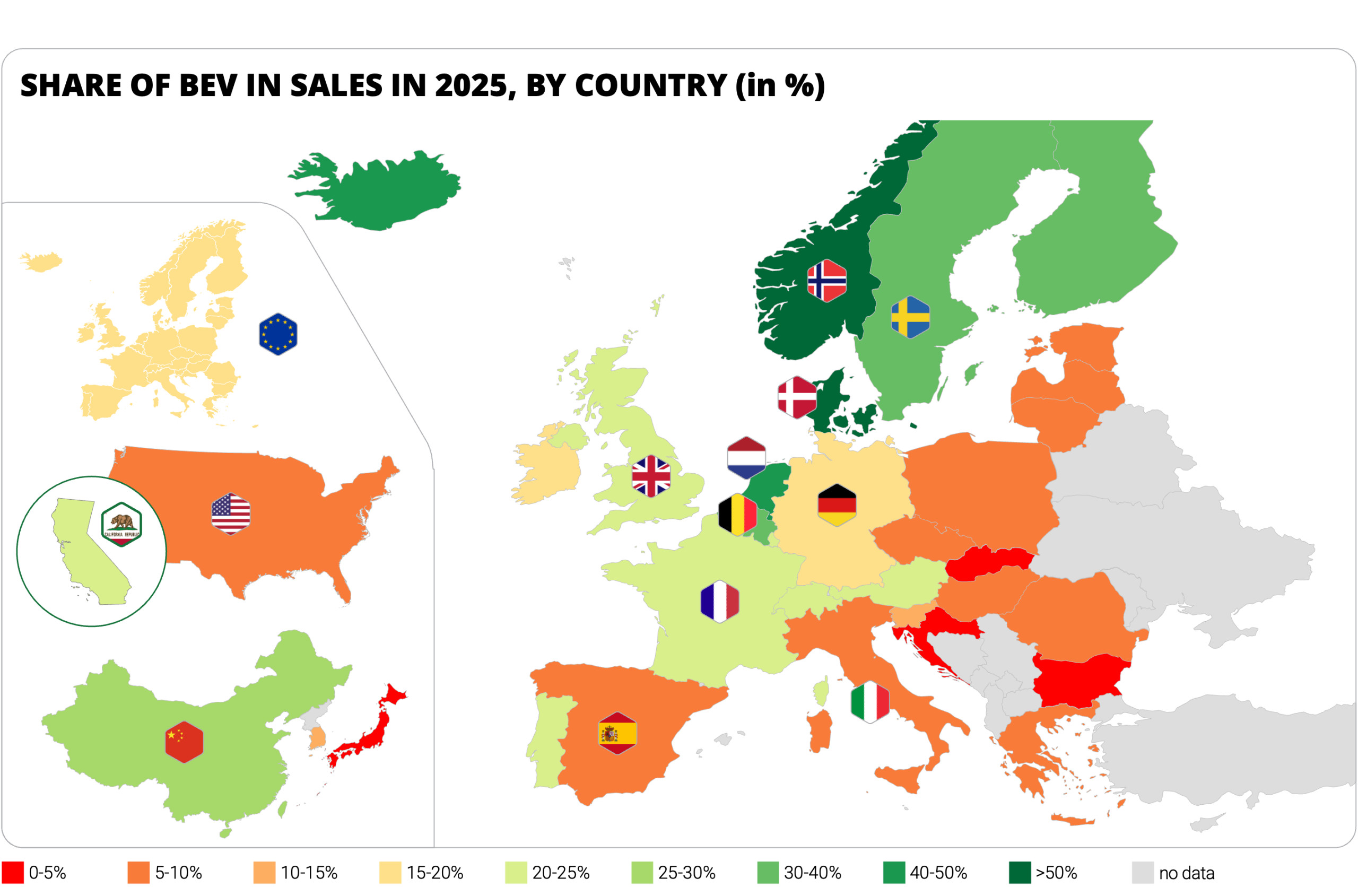
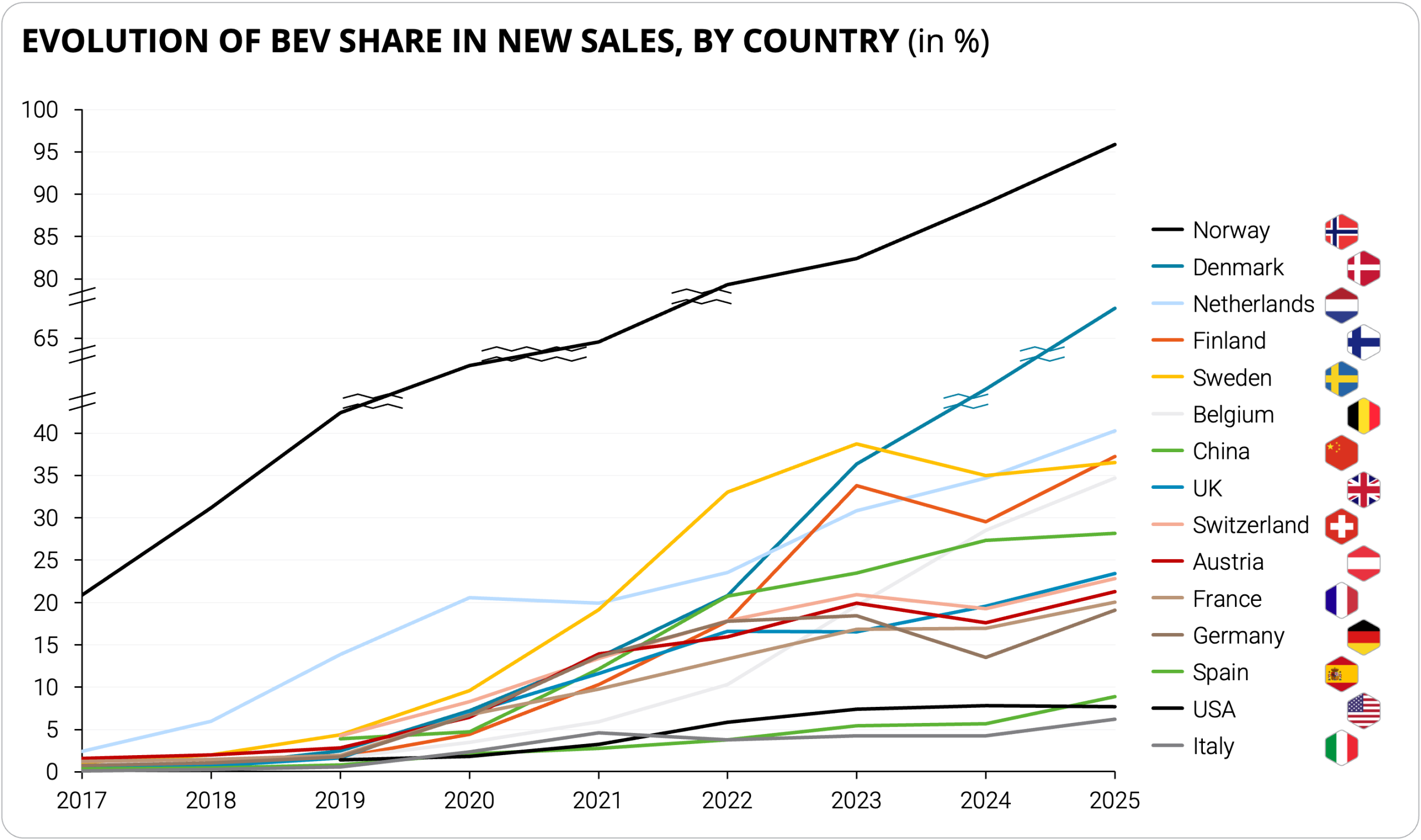
The BEV sales share in Europe declined slightly in 2024 before rebounding strongly in 2025 to 19.5%. Nordics, Benelux, France, the UK, and DACH drove growth, while Southern and Eastern Europe continued to lag, confirming that the market slowdown reflected temporary policy effects rather than weakening structural demand. Norway remains the clear European leader, with BEVs accounting for more than 95% of new-car sales and effectively meeting the European Commission’s 2035 zero-emission benchmark a decade early. Denmark has joined the top tier at 68.5%, while the Benelux countries, Sweden, and Finland have also achieved record BEV shares, underscoring the persistence of northern European leadership.

Figure 1 – Share of BEV in Sales in 2025, by Country (in %)

Source: Berylls by AlixPartners

Belgium demonstrates how targeted corporate-fleet taxation can accelerate electrification. Its BEV sales share rose from 5.9% in 2021 to 34.7% in 2025 after the 2021 reform, which phases out ICE company-car deductibility by 2028 while preserving full deductibility for BEVs. In 2025, about 89% of new BEVs were registered as company cars, underscoring the role of fleets in the BEV transition. This asymmetric policy sharpens the economic case for BEVs, shifts decision-making to fleet managers, accelerates replacement cycles, expands the used-BEV pool, and supports charging build-out. In contrast, more technology-neutral incentives (e.g., Germany’s company-car treatment of BEVs and PHEVs) create a weaker BEV-specific signal.

The UK, France, and DACH recorded BEV shares of 19.0% to 24.0% in 2025, recovering from their 2024 setbacks, indicating that the underlying adoption drivers remained intact despite temporary disruptions.

Germany’s 2024 decline was primarily a policy-timing effect. The abrupt end of the Umweltbonus in December 2023 pulled registrations forward, depressed 2024 volumes, and exposed the private market’s continued dependence on subsidies. Tighter EU CO₂ regulation and later transitional flexibility still preserved rising medium-term pressure on manufacturers to scale BEV sales. Germany still reached a 19.1% BEV sales share in 2025. Expanded model availability across premium and smaller vehicle segments, heightened fuel-price sensitivity, stronger total-cost-of-ownership awareness, and enhanced tax treatment for zero-emission company cars supported demand; early 2026 data suggest that BEV momentum has continued to outpace the overall car market.

Figure 2 – Evolution of BEV Share in New Sales, by Country (in %)

Source: Berylls by AlixPartners

The United States illustrates how fragile BEV demand can be when it depends heavily on short-term federal incentives. The national BEV share has stagnated around 7.5% since 2023, and the expiration of the $7,500 federal tax credit in September 2025 was followed by a sharp decline. Coastal states with strong zero-emission mandates and complementary incentives have sustained materially higher adoption than inland states with EV-negative policy measures.

China reached a record 28.1% BEV sales share in 2025 and operates by far the world’s largest charging network, with more than 20 million charging points and a fleet of more than 40 million new energy vehicles (NEVs), including range-extenders (REEVs), plug-in hybrids (PHEVs), and BEVs. However, the transition is increasingly split between structurally mature Tier 1 and large Tier 2 cities and still underdeveloped rural markets, where sparse infrastructure, weak economics, grid constraints, and land-access barriers limit private investment despite broad highway coverage. Hence, the government’s three-year charging expansion program focuses more on lower-tier and rural markets to unlock the next phase of growth.

Overall, the fastest BEV growth occurs where policy, vehicle supply, and infrastructure send consistent, long-term signals, especially through corporate fleets: Durable, multi-year policy design matters more than short-term subsidies.

BEV Fleet Maturity

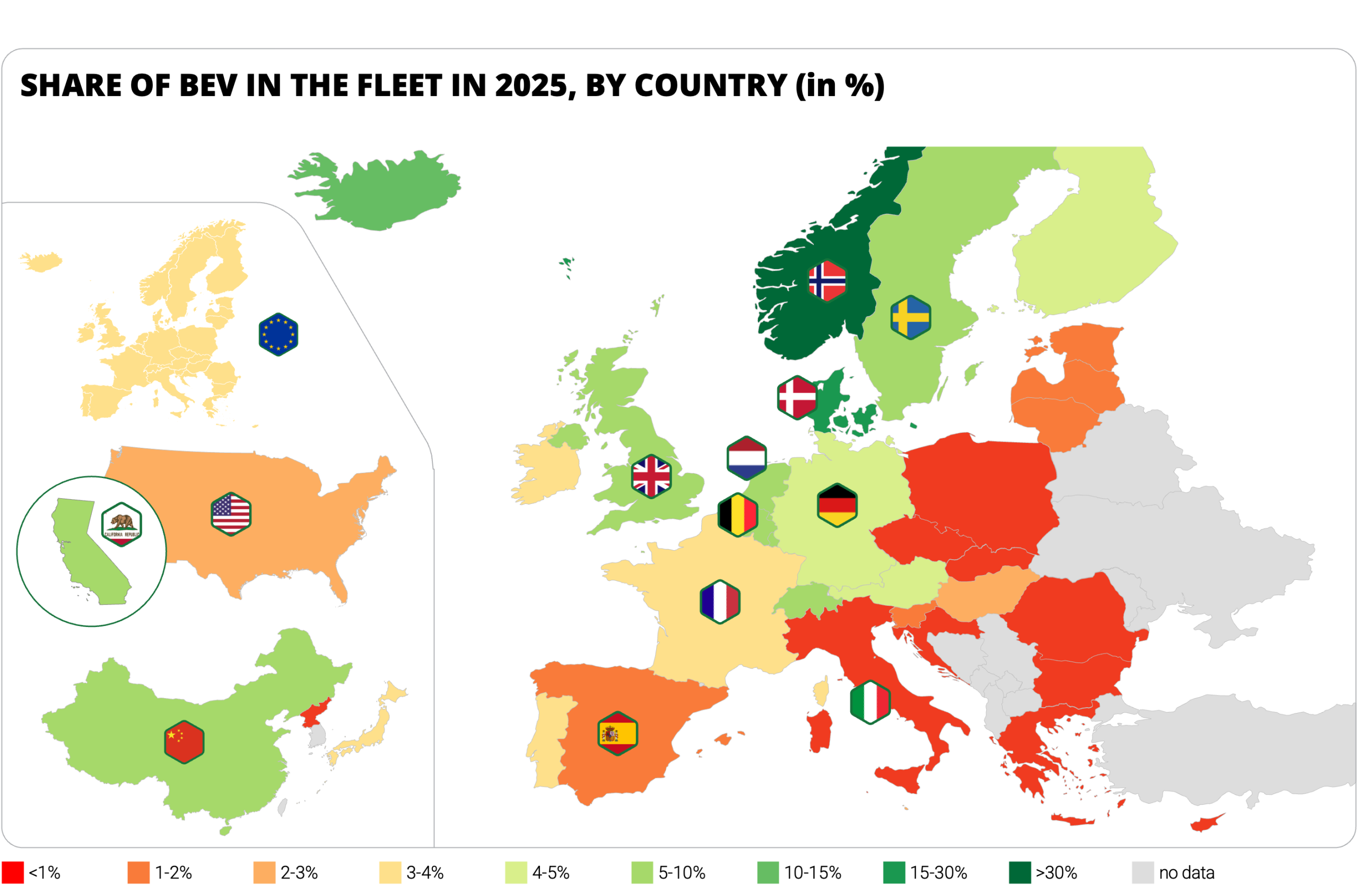
Across Europe, fleet electrification remains in its early stages. In 2025, the average BEV fleet share was only about 3.5%. Fleet composition, rather than sales alone, is the more relevant indicator for long-term emissions, electricity demand, and charging requirements.

Figure 3 – Share of BEV in the Fleet in 2025, by Country (in %)

Source: Berylls by AlixPartners

Norway leads Europe with a BEV fleet share of 32.9%, and Denmark follows at 18.6%, with both far ahead of the rest of the region.

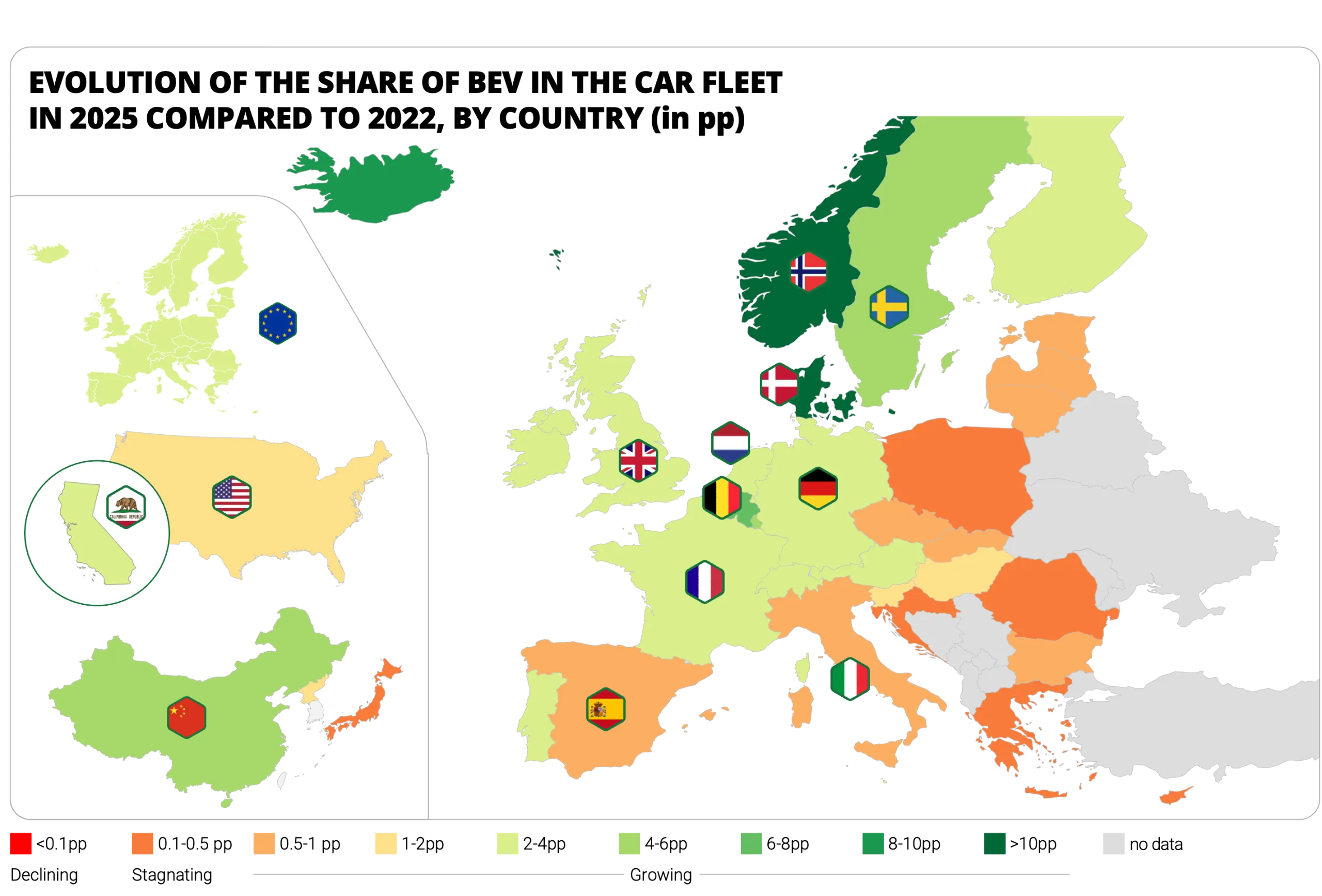
High BEV sales do not translate linearly into fleet electrification as penetration rises. Norway increased its BEV fleet share by less than Denmark did over the same period, despite stronger sales, because at higher penetration levels, new BEVs replace existing electric vehicles rather than combustion cars, and because stock retirement dynamics increasingly slow further gains.

Figure 4 – Evolution of the Share of BEV in the Car Fleet in 2025 compared to 2022, by Country (in pp)

Source: Berylls by AlixPartners

Eastern Europe illustrates the opposite problem: Low recent BEV sales have locked in large volumes of new ICE vehicles with long remaining lifetimes beyond 2035, implying that even stronger future BEV sales would translate only gradually into fleet change.

The broader implication is that fleet maturity depends on sustained, high BEV sales over many years rather than on short-term registration peaks. For policymakers and infrastructure providers, this means fleet-based indicators should guide expectations for energy demand, emissions reductions, and charging deployment more than annual sales shares alone.

Forecast 2035

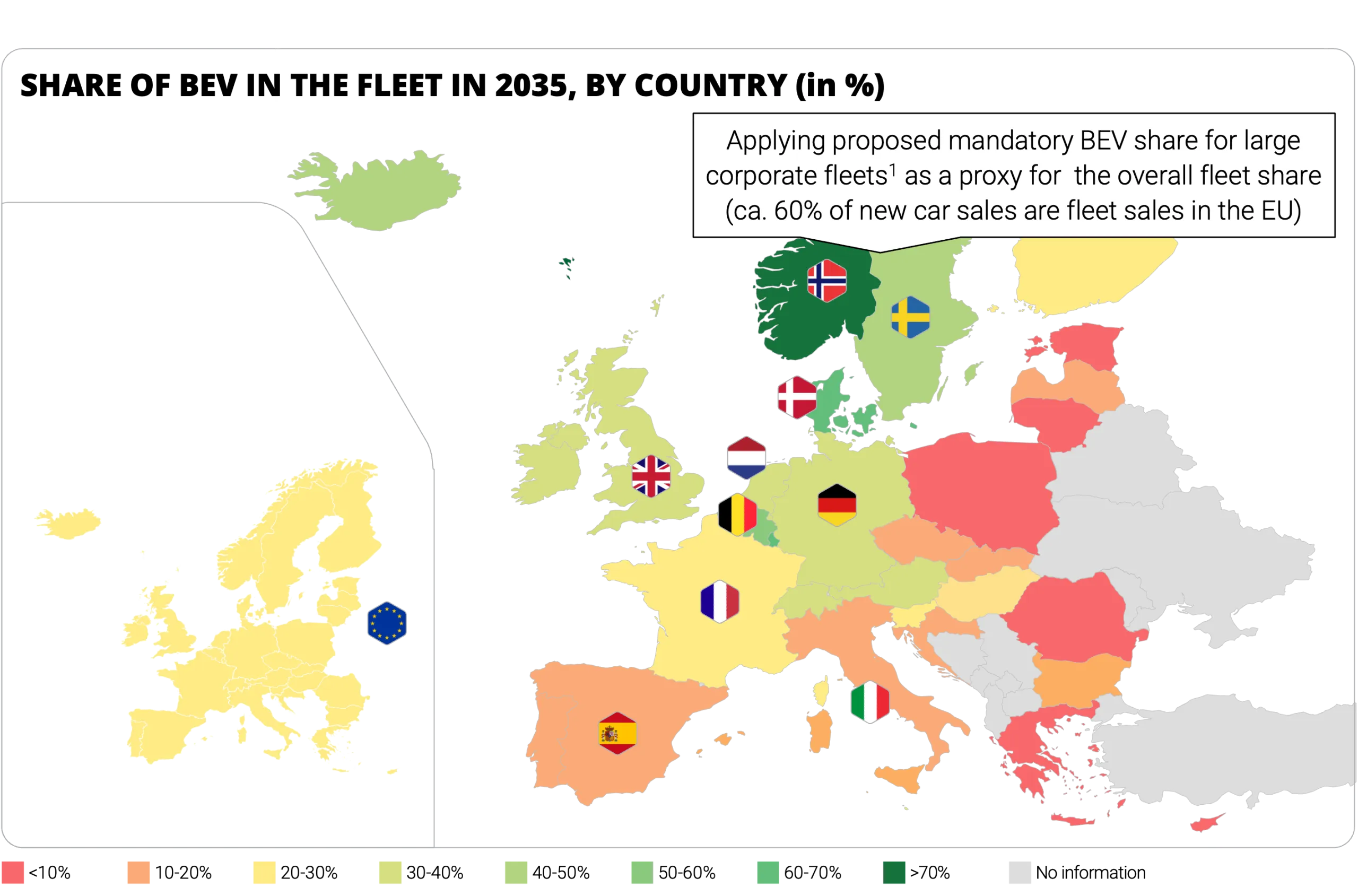
By 2035, Europe’s BEV fleet is expected to be much larger but still far from fully electrified. The scenario translates the EU’s 2025 Automotive Package into country-specific 2035 BEV sales shares by interpolating from current levels to the proposed national targets for zero-emission corporate car registrations, providing an order-of-magnitude view of how the fleet could evolve under full implementation.

This scenario is intentionally simplified and should be read as illustrative rather than predictive. It assumes that the proposed targets are fully enacted and achieved across corporate and private registrations, even though political resistance could delay, dilute, or block the package. As a result, the resulting fleet figures serve primarily as a reference case for comparing transition dynamics across countries.

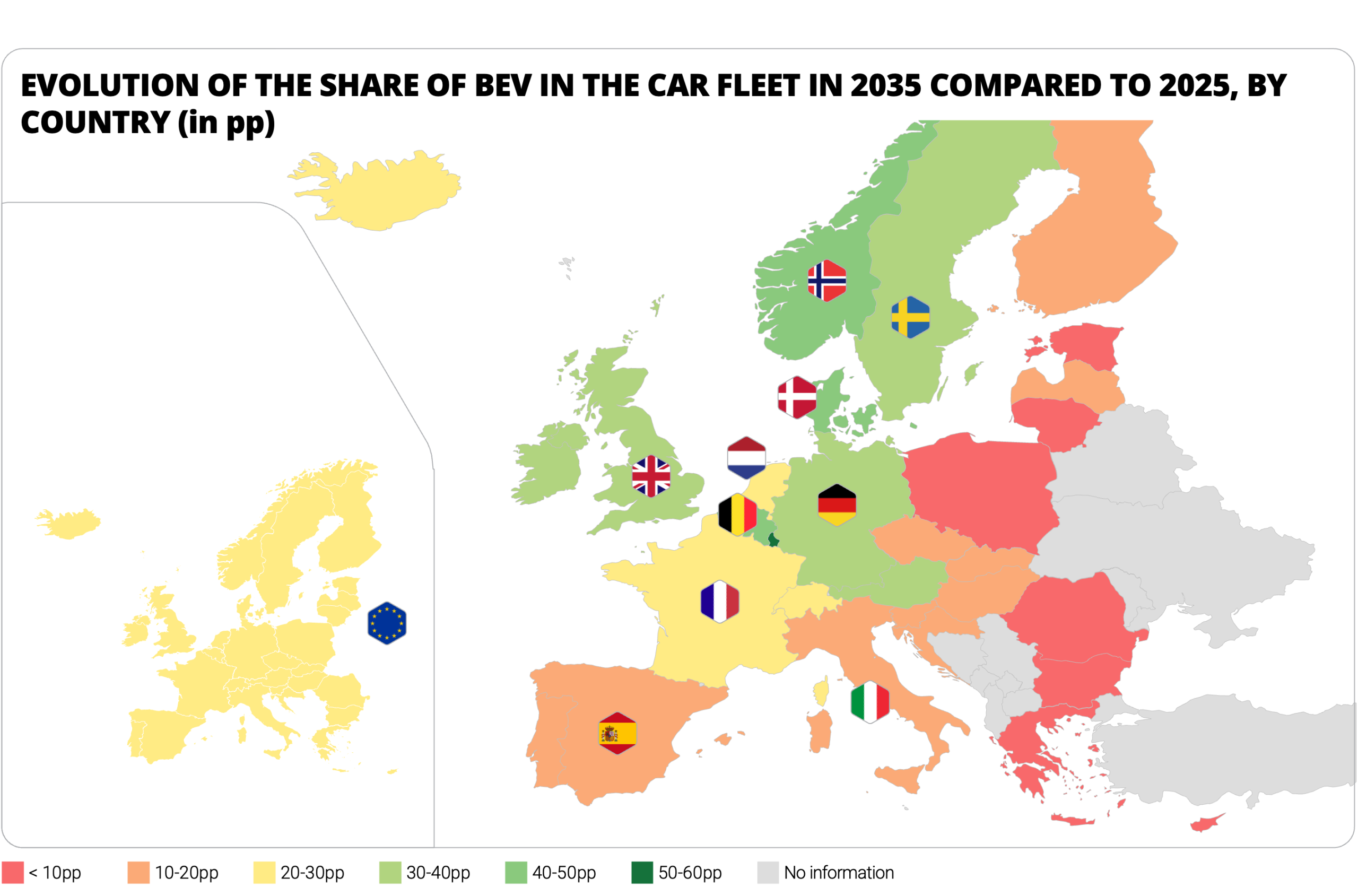
Norway and Denmark are expected to remain the leaders. Even under this supportive policy scenario, Europe’s average BEV fleet share would reach only about 26% by 2035, implying that combustion vehicles would still dominate the parc well into the next decade.

Figure 5 – Share of BEV in the Fleet in 2035, by Country (in %)

Source: Berylls by AlixPartners

Figure 6 – Evolution of the Share of BEV in the Car Fleet in 2035 compared to 2025, by Country (in pp)

Source: Berylls by AlixPartners

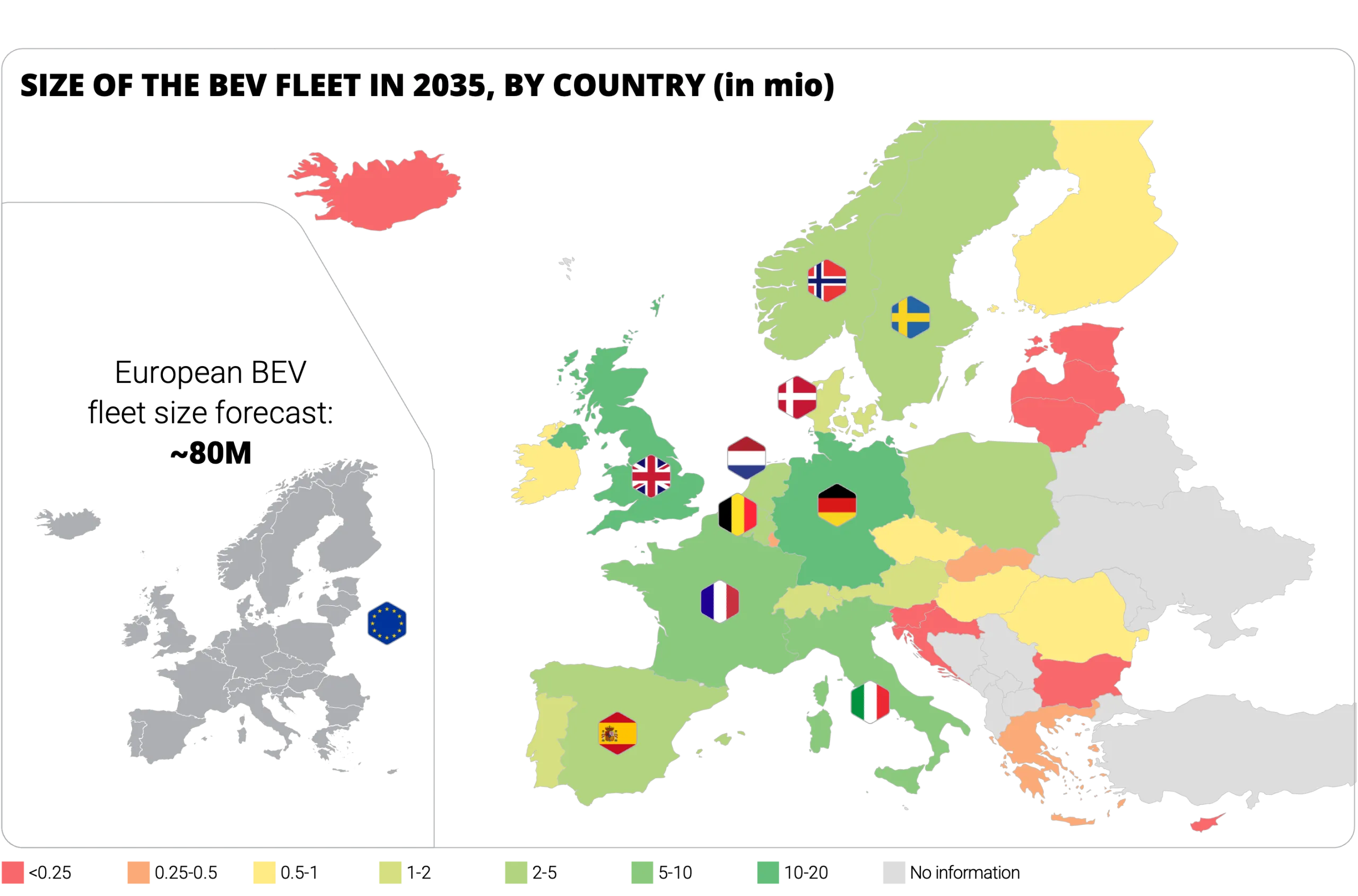
Europe’s BEV stock is projected to grow from 10.7 million vehicles in 2025 to about 80 million in 2035, raising estimated daily energy demand from 87.1 GWh to over 350 GWh. Demand growth will be driven less by the highest-penetration markets than by large countries with sizable fleets and medium-to-high BEV shares, especially Germany and the UK, followed by France, Italy, and Spain.

Figure 7 – Size of the BEV Fleet in 2035, by Country (in mio)

Source: Berylls by AlixPartners

The overall pattern is a two-speed transition. Northern and Central Europe are likely to consolidate as the main centers of BEV stock and charging demand, while Southern and Eastern Europe remain structurally behind, suggesting that investors should anchor portfolios in large, mature markets. At the same time, policymakers in lagging regions focus on fleet incentives, stock renewal, and stronger scrappage or export economics for older combustion vehicles.

Charging Infrastructure

As BEVs become structurally significant within national fleets, public charging is shifting from a peripheral service to a core infrastructure asset. The key issue is no longer only network presence but whether charging systems are dense, convenient, and economically sustainable at scale.

Cross-country comparisons require a maturity lens. Metrics such as chargers per inhabitant or installed kW per BEV can be misleading if read without accounting for fleet size, charging behavior, private-charging availability, and the regulatory stage of network roll-out.

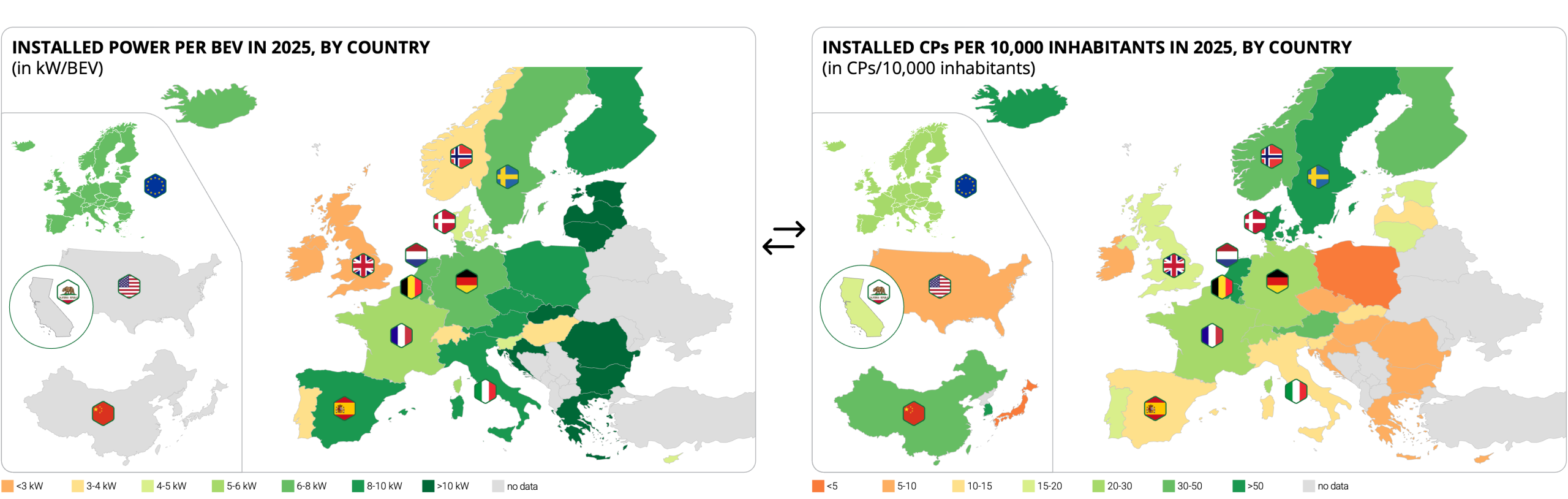
Figure 8 – Comparison of Installed Power per BEV in 2025, by Country (in kW/BEV) and the Installed CPs per 10,000 inhabitants in 2025, by country (in CPs/10,000 inhabitants)

Source: Berylls by AlixPartners

In mature markets such as the Nordics and Benelux, public infrastructure is supported by high BEV penetration and extensive private charging. Norway illustrates this dynamic: high home-charging intensity reduces reliance on public charging, so lower installed public power per BEV does not necessarily indicate undercapacity. For operators, the focus increasingly shifts toward site quality, utilization, use-case segmentation, and yield optimization rather than pure expansion.

Southern and Eastern European markets often show the opposite pattern. Their high installed power per BEV frequently reflects corridor-led early deployment under AFIR and TEN-T requirements rather than a fully developed everyday charging network. As a result, seemingly strong kW-per-BEV ratios can coexist with weak urban or regional coverage and low accessibility outside major routes.

This distinction is strategically important. Large, mature markets such as DACH, the UK, France, the Nordics, and Benelux already provide the most predictable charging demand and therefore form the cash-flow backbone of infrastructure portfolios. Southern and Eastern Europe offer the primary growth option through selective early positioning along corridors and in urban nodes, but they also carry higher regulatory, demand, and utilization risk.

Conclusion

The analysis underscores that e-mobility is no longer a speculative bet but an investable reality, shaped by stable regulatory frameworks, fleet economics, infrastructure quality, and appealing vehicles. For policymakers, OEMs, and infrastructure investors, the strategic task is to align policy design, product portfolios, and charging deployment with these structural trends, turning today’s uneven landscape into a resilient, scalable, and geographically broader electrification of road transport.

Authors

Dr. Alexander Timmer

Partner & Managing Director

Andreas Radics

Partner & Managing Director

Dr. Xing Zhou

Partner & Managing Director

Henning Ludes

Associate Partner

Julien Petat

Consultant

Timo Natemeyer

Consultant